Last updated 2026-08-21
TL;DR
Ice-machine tech is field work on commercial ice makers: clean, repair, recover refrigerant, and keep ice safe to eat. Start with EPA Section 608 (Type II or Universal), then your state HVAC or refrigeration board, then business paper and insurance if you invoice on your own. Pay sits inside HVACR. BLS put the HVACR median wage at $57,300 in May 2023. Confirm every fee with the board that issues it.
What is ice-machine tech?
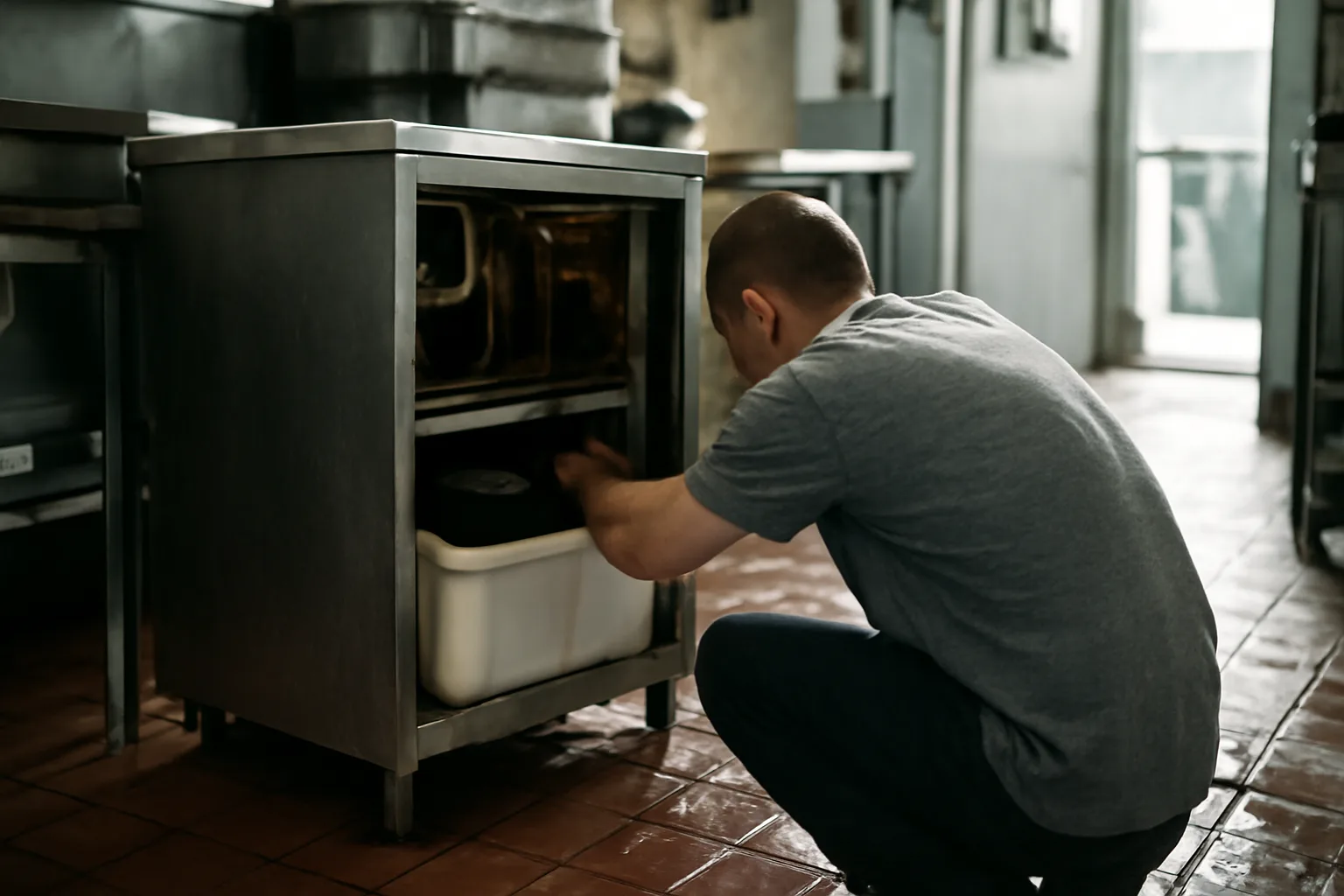
Ice-machine tech is field refrigeration work on commercial ice makers. You service the refrigeration circuit, the water path, the harvest system, and the bin that holds ice people eat. It is HVACR with more scale, more sanitation, and more 2 a.m. out-of-ice calls than a typical rooftop job.
The machines sit in restaurants, hotels, hospitals, c-stores, and stadiums. Cube, half-dice, nugget, flake, and scale ice fail in different ways. A cuber with a dirty evaporator is one ticket. A flake machine with a worn auger is another.
You recover refrigerant, find leaks, replace water pumps, clean evaporators, swap inlet valves, and chase flaky control boards. A lot of the week is not heroic. It is nickel-safe cleaner, a decent inspection mirror, and knowing when a clogged condenser is the whole job.
Federal law does not issue an ice-machine tech license. EPA Section 608 covers refrigerant handling on this equipment the same way it covers other stationary refrigeration. [5] State boards may add HVAC or refrigeration contractor or technician cards. Confirm that with the board that would fine you.
BLS does not split ice-machine techs out as their own occupation. Pay and headcount live inside heating, air conditioning, and refrigeration mechanics and installers. [1] If someone sold you a national ice-machine license, they sold you a story. The paper path is 608, then your state, then local tax and insurance.
How do you start ice-machine tech?
You start with EPA Section 608 certification (Type II or Universal), then you check your state HVAC or refrigeration board, then you set up a legal way to invoice if you are not an employee. That order matters. Manufacturer classes do not replace 608.
Pass EPA 608 through an approved certifier. EPA does not mail you a federal ice-machine card. It requires technician certification before you maintain, service, repair, or dispose of appliances that could release refrigerants. [2] Type II matches most commercial ice machines, which are high-pressure appliances. Universal is the exam I would sit for, because you will touch other equipment on the same dock.
Call the state contractor board next. Ask whether ice-machine service for hire needs a refrigeration or HVAC contractor license, a technician registration, or only work under a licensed employer. Texas puts air conditioning and refrigeration contracting in Occupations Code Chapter 1302. [7] California describes refrigeration contracting under the C-38 classification. [8] Other states are lighter. Fees and forms change. Confirm with the board. Do not copy a blog fee.
If you will work for yourself, pick a structure, get an EIN if you need one, and handle local business licensing. The SBA 10-step guide is a decent checklist for the generic business layer, not the refrigerant layer. [9] Buy recovery gear that meets EPA rules, a vacuum pump, a scale, gauges or a digital manifold, nitrogen, a leak detector, and sanitation chemicals that match evaporator materials.
Insurance comes before the first invoice. Start with the liability notes for techs and confirm limits with a broker who actually writes HVACR. Find accounts through restaurant groups, facility managers, and comfort-cooling shops that hate ice machines. That gap is your opening.
Do you need EPA 608 to work on ice machines?
Yes, if the work could release regulated refrigerant. Ice-machine tech on a charged commercial cuber is stationary refrigeration work, not a hobby exemption. EPA’s technician page says technicians who maintain, service, repair, or dispose of equipment that could release ozone-depleting refrigerants or their substitutes must be certified. [5]
40 CFR 82.161 is the certification rule. It is the paper that actually follows you into a leaky receiver, not a brand diploma. [2] 40 CFR 82.154 is the venting rule. It says no person maintaining, servicing, repairing, or disposing of appliances may knowingly vent or otherwise release refrigerant from those appliances, with listed exceptions. [4]
Sit Type II at minimum. Sit Universal if you can. Type I is small appliances. Type III is low-pressure chillers. Commercial ice makers are not those. EPA states, “Section 608 technician certifications are good for life.” [3] That is the quote. You still have to follow current recovery and sales rules even if the card never expires.
EPA does not publish a national exam price. Third-party certifiers charge. Confirm the current amount with the outfit giving the test. I would not pay extra for a “premium ice” sticker on the same 608 content.
| 608 type | What it covers | Ice-machine fit |
|---|---|---|
| Type I | Small appliances | Rare on commercial cubes |
| Type II | High-pressure appliances | Most commercial ice makers |
| Type III | Low-pressure appliances | Not ice makers |
| Universal | All three types | What I would sit for |
What state license does an ice-machine tech need?
It depends on the state, the contract size, and whether you are an employee or the person offering the work for hire. There is no single U.S. ice-machine tech license. Some states treat this as refrigeration contracting. Some fold it into HVAC. Some mainly care if you pull permits or advertise as a contractor.
Texas Occupations Code Chapter 1302 is the air conditioning and refrigeration statute. If you will contract that work in Texas, read that chapter and then confirm current classes, exams, and fees with TDLR. [7] California’s Description of Classifications spells out C-38 refrigeration contracting as the box that includes refrigeration equipment construction, installation, and maintenance. [8] Those two are examples, not a 50-state map.
A lot of new techs work as employees of a licensed contractor and never hold the contractor card themselves. That can be legal. It can also be a trap if you start invoicing restaurants under your own name. The moment you offer ice-machine tech for hire, you may have crossed into contracting. Confirm with the board. I would not take a Facebook group’s word for it.
Local business tax, sales tax on parts, and city contractor registrations stack on top. None of that is EPA 608. Census NAICS 238220 (plumbing, heating, and air-conditioning contractors) is the industry box that usually includes refrigeration contracting when you are filling forms. [13] Use it on paper. Do not assume it grants a license.
What paper should you have in year one?
Year-one paper for ice-machine tech is boring and specific: EPA 608 card, state or local contractor or technician credential if required, a way to invoice legally, recovery records, and insurance certificates customers will actually accept. That stack beats a laminated “certified ice specialist” from a weekend class.
Keep copies of 608, any state card, your recovery machine’s certification if applicable, and SDS sheets for cleaners. Foodservice accounts will ask. Hospitals will ask more. If you are self-employed, IRS self-employment tax is 15.3 percent (12.4 percent Social Security and 2.9 percent Medicare), and you confirm current filing rules in IRS materials, not a forum. [10]
SBA’s start checklist covers structure, EIN, and licenses at a generic level. [9] Pair that with your board, not instead of it. I would skip forming three LLCs and buying a trademark in month one. One clean entity, one bank account, one certificate of insurance.
Customers will also want proof you can cover a flooded kitchen. Have the certificate process figured out before you promise a same-day COI. If a chain vendor packet asks for extra insured language, read additional insured requests before you say yes on a loading dock.
How much does ice-machine tech pay?
Nobody publishes a clean national wage just for ice-machine tech. The closest official bucket is HVACR. BLS reported a median annual wage of $57,300 for HVACR mechanics and installers in May 2023. [1] That figure is not an ice-only promise. It is the honest public number.
The same BLS profile put employment at 397,900 jobs in 2022, projected 6 percent growth from 2022 to 2032, and about 37,700 openings per year. [1] Ice work can pay above a residential changeout average when you own a route and parts margin. It can also pay worse if you only sell cheap cleans and eat callbacks.
Commission or route splits inside a dealership vary wildly. I have never seen a government series I trust for those splits. If a recruiter quotes a number, ask whether it is W-2, includes a van, and counts after warranty chargebacks.
Self-employed ice-machine tech income is revenue minus parts, fuel, insurance, and the 15.3 percent self-employment tax layer. [10] Do not confuse a $180 service call with a wage. One no-ice Saturday does not make a year.
What tools are worth buying first?
Buy recovery equipment you will use legally, a vacuum pump that actually pulls down, a refrigerant scale, a leak detector, nitrogen with a regulator, basic hand tools, a megohmmeter if you work motors, and the right cleaner for the evaporator metal in front of you. That kit starts ice-machine tech. A wrapped van does not.
EPA rules on who may recover and how you handle refrigerant sit in Subpart F, including 82.154 and the certification rule in 82.161. [4] [2] A pretty gauge set is not a substitute for recovery. I would buy used quality recovery gear before a new scan tool you cannot explain.
Sanitation tools matter more than people admit. Brushes, a good flashlight, food-grade bin cleaner, and nickel-safe product for nickel evaporators prevent the callback that eats your Saturday. Wrong acid on the wrong plating is how you buy an evaporator.
Skip giant brand-specific board inventories until you have a route. Boards are expensive and go obsolete. If you want a paper bundle for Manitowoc and Hoshizaki route work, IceMachinePath sells a $149 one-time Route Kit. You do not need it to follow this guide, and this path still works if you never buy it.
Lockout habits belong next to the tool bag. OSHA’s lockout/tagout standard (29 CFR 1910.147) is the energy-control rule for machines that can start while you are in them. [11] Flake augers do not care that you were “only looking.”
Is ice food, and does that change the job?
Yes. Ice that goes in drinks is food. That changes how you clean, what you put in a bin, and how picky a health inspector can be. FDA Food Code 2022 section 3-202.16 states, “Ice for use as a FOOD or a cooling medium shall be made from DRINKING WATER.” [6]
You are not the health department. You still own the moment you dump a filthy bin into a clean one, leave scale in the water trough, or store a pump on ice. I treat scoops, bin walls, and splash zones as food-contact adjacent even when a manager does not.
Drinking-water supply, backflow, and filter changes are part of ice-machine tech, not extras. A beautiful charge on a machine fed by a dead filter still makes ugly ice. Confirm local plumbing rules if you alter water lines. Some jurisdictions want a plumber for that portion. I would rather lose a small add-on than argue with an inspector.
NSF/ANSI equipment listings apply to the machine as built. They are not your personal license. Do not tell a customer you are “NSF certified” because you wiped a listed cuber.
What insurance does a new ice-machine tech need?
If you invoice on your own, you need general liability before you pull a panel in someone else’s kitchen. Many accounts will not let you on site without a certificate. Work comp rules depend on whether you have employees and on your state. Auto coverage on a parts-loaded van is not optional if you drive to jobs.
I would not open a route on a personal auto policy and a hope. Tools coverage and inland marine get ignored until a pump thief visits the driveway. Read tools and van coverage before you load $8,000 of recovery gear overnight.
Flooded floors and slip claims are the boring risk. Refrigerant and water leaks are how ice-machine tech meets a lawyer. Water damage questions are worth a pass before you quote a 20-year-old bin drain. If you hire help, work comp basics matter more than a new logo.
Limits, extra insured wording, and waivers of subrogation show up in chain vendor packets. Confirm with a licensed broker. IceMachinePath is not an insurer. For policy language fights, certificate holds and claim timing notes are the next clicks, not a substitute for the broker.
How do first-year operations actually work?
First-year ice-machine tech is mostly preventive cleans, no-ice emergency calls, and parts you cannot get until Tuesday. A real week is three scheduled PMs, two “we have a banquet” panics, and one leak that needs recovery you already knew how to do because you sat 608.
I price a clean that includes the evaporator, condenser, bin, and a written water-quality note. Cheap 20-minute spray jobs train customers to call you at 9 p.m. when harvest fails. Ninety-day PMs are common in foodservice. That interval is a practice, not a federal statute. Match it to water hardness and machine type.
Parts float will eat cash. Keep inlet valves, pumps, a couple of common controllers, and cleaner. Do not stock every harvest assembly “just in case.” Track what you actually burn in 90 days. Then stock that.
Electrical work still has OSHA rules. 29 CFR 1910.333 covers safety-related work practices, including treating circuits as live until you prove they are not. [12] Ice machines sit on dirty dedicated circuits behind kegs. Prove it dead. Then work.
Keep a simple job record: model, serial, refrigerant type, ounces in and out, what you cleaned, what you quoted next. That record is how you survive warranty arguments and state questions. It is also how you notice a location that destroys machines with bad water.
What is a waste of money when you start?
A waste of money is anything that does not get you 608, legal status, recovery gear, or a customer who pays. National “ice associations” with no board standing, $4,000 mystery tool crates, and van wraps before your first account are ego spend.
I would not buy every OEM class in month one. Take the class when you are drowning in one brand’s controller. Until then, wiring diagrams and a patient meter get most tickets done. I would not lease a new van on a three-account route.
Be careful with license coaches who promise the board will rubber-stamp you. Boards do not pre-approve blog packages. Confirm exams, experience affidavits, and fees with the issuing board. Anyone quoting a processing time they cannot show on a board page is guessing.
Another leak is underinsured jobs. One bin overflow can cost more than a year of premium. Pair the liability notes with a real quote. Cheap insurance that excludes water damage is a coupon, not a plan.
How do you confirm board rules before you bid?
You confirm ice-machine tech rules by reading the statute or classification, then calling or checking the live fee page of the board that can fine you. Do not treat this article as a license. IceMachinePath is an independent publisher, not a law firm and not a service company.
For refrigerant handling, the federal floor is Section 608 and 40 CFR Part 82, Subpart F. [2] [4] [5] For contracting, start with your state HVAC or refrigeration practice act. Texas Chapter 1302 and California’s C-38 description are models of the documents you want, not a substitute for your state. [7] [8]
Ask the board three questions: Does service-only ice work for hire require a contractor license? Does an employee of a licensee need a technician registration? What is the current fee on the board’s fee page? Write down the date and the name of the page. Fees move.
If you still want a paper kit and a start checklist after that homework, use /start. The job still begins with 608, the board, and a customer who needs ice.
Frequently asked questions
What is ice-machine tech?
Ice-machine tech is specialized HVACR field work on commercial ice makers. You clean water systems, repair harvest and refrigeration parts, recover refrigerant under EPA Section 608, and keep ice that people eat from a dirty bin. It is not a separate federal license. BLS counts the workers inside HVACR mechanics and installers.
How do you start ice-machine tech?
Get EPA Section 608 (Type II or Universal), then confirm HVAC or refrigeration contractor or technician rules with your state board, then set up invoicing, tax, and insurance if you are not an employee. Buy recovery gear and sanitation tools before marketing. Manufacturer classes help later. They do not replace 608 or a required state card.
Is EPA Type II enough for commercial ice makers?
Type II covers high-pressure appliances, which is the usual commercial ice-machine category. Universal includes Type II plus small-appliance and low-pressure work. I would sit Universal so one card covers mixed equipment on the same site. Confirm current exam content with an EPA-approved certifier. Cards do not expire under EPA’s FAQ.
Do Section 608 cards expire?
EPA says Section 608 technician certifications are good for life. You still must follow current recovery, leak, and refrigerant sales rules. A lifetime card is not a lifetime pass to vent. Read 40 CFR 82.154 and 82.161, and confirm any state overlay with your board.
Can I service ice machines without a contractor license?
Sometimes, if you are an employee of a properly licensed contractor or if your state does not treat service-only work as contracting. The moment you advertise ice-machine tech for hire, many states treat you as a contractor. Texas Chapter 1302 and California C-38 are examples of real statutes and classifications. Confirm with your board before you bid.
How much is the EPA 608 test?
EPA does not set a single national exam price. Approved third-party certifiers charge their own fees, which move. Confirm the current amount with the testing outfit. I would not pay a premium for ice-branded wrapping on the same 608 content. Budget for the test, not for a fake federal ice license.
Do I need manufacturer certification to work on ice machines?
No federal rule says you need a brand diploma to turn a wrench. OEM classes help on proprietary controls and warranty politics. They do not replace EPA 608 or a state contractor card. Take a brand class when that brand is filling your week. Until then, diagrams, 608, and sanitation skill do the work.
What refrigerant is in commercial ice machines?
It varies by age and model. You will still see older HFC blends and newer lower-GWP or hydrocarbon charges on some machines. Identify the nameplate before you add anything. Type II or Universal 608 is the handling paper. Do not assume every cuber is the same drum you keep in the van.
Is a recovery machine required?
If you will remove refrigerant, you need to recover it under Section 608 rules rather than venting it. 40 CFR 82.154 prohibits knowingly venting refrigerant during maintenance, service, repair, or disposal, with listed exceptions. Buy recovery gear that meets the rules. A manifold alone is not a recovery plan.
Can I start ice-machine tech as a side job?
You can, if 608, state contracting rules, insurance, and your day-job contract allow it. Side work without a contractor card or with a personal auto policy is how people get fined or uncovered. Confirm moonlighting clauses and board rules first. Evenings-only routes still flood kitchens.
Does BLS track ice-machine techs separately?
No. BLS reports heating, air conditioning, and refrigeration mechanics and installers as one occupation. The May 2023 median wage in that handbook profile was $57,300. Treat ice-only pay claims on social media as anecdotes unless someone shows payroll data.
Are ice bins a food-contact problem?
Ice used as food or a cooling medium must be made from drinking water under FDA Food Code 2022 section 3-202.16. Dirty bins, stored parts on ice, and filthy scoops are how you fail a walk-through. Clean like the ice will be eaten, because it will.
Should I get Universal 608?
Yes if you can. Type II covers most ice machines. Universal adds flexibility when a site also has small appliances or other systems. EPA certifications do not expire. One test that covers mixed equipment is cheaper than discovering Type II is not enough on a different box.
Do I need a business license to work on ice machines?
If you invoice as your own firm, you typically need local business licensing plus whatever state contractor paper applies. Employees of a licensed contractor may not need their own business license. SBA’s 10-step guide covers the generic layer. Confirm city and board requirements. Do not assume an EIN is a contractor license.
Sources
- U.S. BLS Occupational Outlook Handbook, HVACR mechanics and installers: Median annual wage of $57,300 in May 2023, 397,900 jobs in 2022, 6 percent projected growth for 2022-32, about 37,700 openings per year
- eCFR 40 CFR 82.161 Technician certification: Federal technician certification is required for persons who maintain, service, repair, or dispose of appliances that could release refrigerants
- eCFR 40 CFR 82.154 Prohibitions: Knowingly venting refrigerant from appliances during maintenance, service, repair, or disposal is prohibited except as provided
- FDA Food Code 2022 (PDF): Section 3-202.16 requires ice for use as a food or a cooling medium to be made from drinking water
- Texas Occupations Code Chapter 1302, Air Conditioning and Refrigeration Contractors: Texas regulates air conditioning and refrigeration contracting in Occupations Code Chapter 1302
- CSLB Description of Classifications (C-38 Refrigeration): California C-38 refrigeration contractor classification covers refrigeration equipment construction, installation, and maintenance
- U.S. Small Business Administration, 10 steps to start your business: SBA outlines structure, EIN, and licensing steps for starting a business
- IRS, Self-employment tax (Social Security and Medicare taxes): Self-employment tax rate is 15.3 percent, consisting of 12.4 percent Social Security and 2.9 percent Medicare
- OSHA 29 CFR 1910.147 The control of hazardous energy (lockout/tagout): Employers must control hazardous energy with lockout/tagout procedures on machines being serviced
- OSHA 29 CFR 1910.333 Selection and use of work practices: Safety-related electrical work practices include treating circuits as live until they are verified deenergized
- U.S. Census Bureau NAICS 2022 definition, 238220: NAICS 238220 covers plumbing, heating, and air-conditioning contractors, including refrigeration contracting activity