Last updated 2026-08-21
TL;DR
Ice-machine tech is field work on commercial ice makers. There is no U.S. national ice-machine license. Start with EPA Section 608 if you touch refrigerant, then follow your state's HVAC or refrigeration contractor rules if you bill on your own. First year is ride-alongs and scale cleanings. Confirm every fee with the board that issues the card.
What is ice-machine tech?
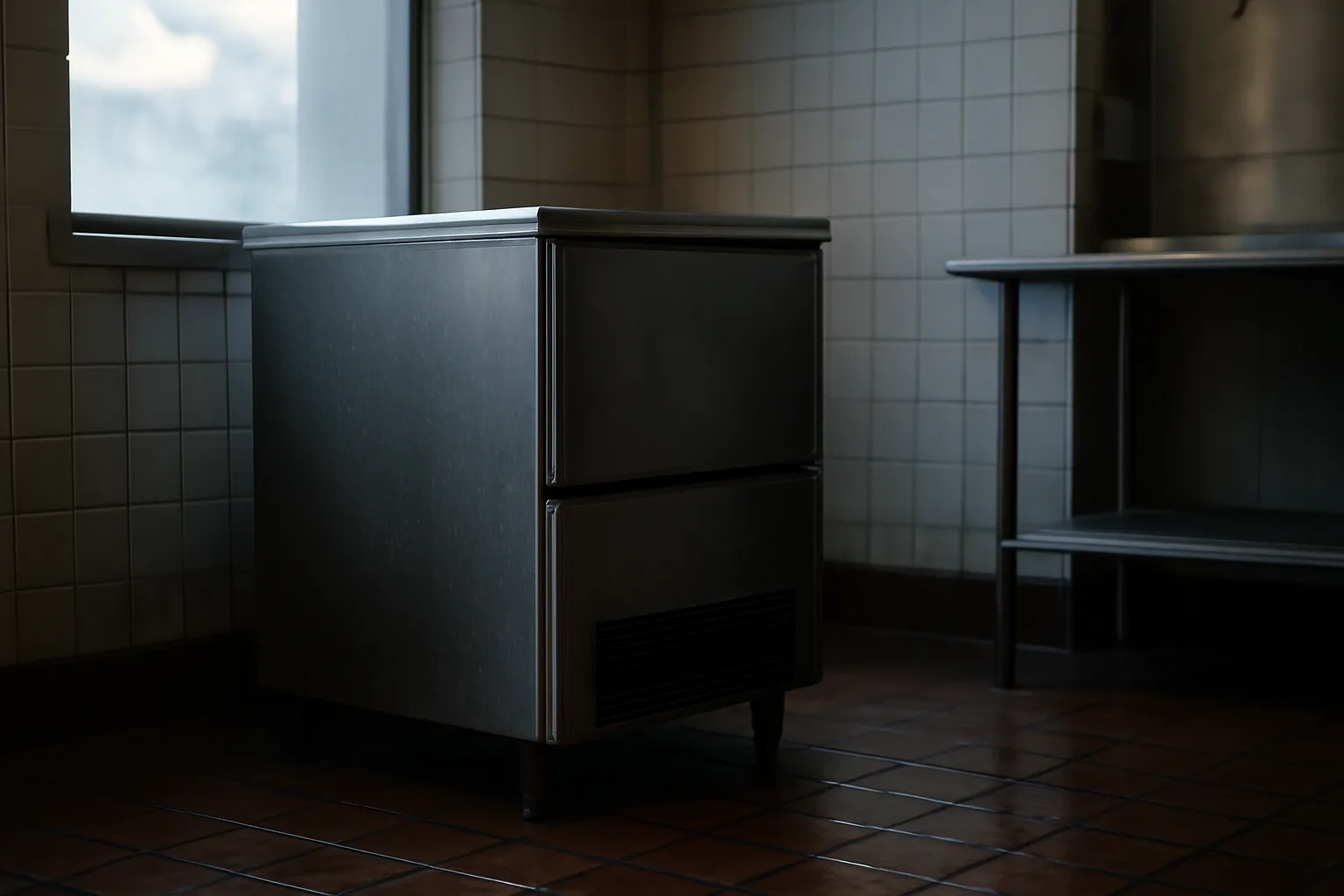
Ice-machine tech is the field trade that installs, cleans, diagnoses, and repairs commercial ice makers in restaurants, hotels, hospitals, and stores. It sits inside HVAC/R. It is not a separate U.S. occupational license. Most of your hours go to water, scale, and harvest problems, not compressor changes.
You live on cube, nugget, and flake machines. Inlet valves stick. Pumps cavitate. Evaporators lime up until harvest fails. Condenser coils load with grease from a fryer ten feet away. When the sealed system is actually open, you recover, leak-check, repair, evacuate, and weigh in the nameplate charge.
BLS does not publish an ice-only occupation. The closest bucket is heating, air conditioning, and refrigeration mechanics and installers. BLS reported a $57,300 median annual wage for HVAC/R mechanics and installers in May 2023. [3]
Ice is food. The FDA Food Code states, "Ice for use as a food or a cooling medium shall be made from drinking water." [4] Inspectors fail slimy bins. A tech who can clean to that standard stays booked even in weeks with no leak jobs.
The work is route-shaped. Accounts call when the bin is empty, and that is usually the worst moment in their week. You need a calm diagnostic order: power, water, condenser air, controls, then refrigerant.
How do you start ice-machine tech?
You start by getting onto a commercial refrigeration or ice-dealer truck, earning EPA Section 608 Type II or Universal before any sealed-system work, and checking whether your state requires a contractor license once you bill customers yourself. There is no national ice-machine license. Confirm every fee with the board that issues the card.
Hire on first if you can. A dealer already has recovery gear, nitrogen, and a senior tech who knows which KM or Indigo fault code is a wild goose chase. Sitting 608 in a vacuum, then buying a van, is how people light money on fire.
EPA Section 608 certification is the one nationwide paper that follows refrigerant work. EPA requires certification for technicians who maintain, service, repair, or dispose of equipment that could release refrigerants. [1] 40 CFR 82.161 requires a current and valid technician certificate before a person performs those listed activities. [2]
I would sit Universal. Type I covers many factory-sealed machines with five pounds of refrigerant or less. Type II covers other high-pressure appliances. You will meet both on the same property, plus a reach-in cooler that is not an ice maker at all.
State contracting paper comes next, but only if you sell the job yourself. Employees of a licensed contractor often work under the company license. Independent invoices can count as contracting. That line is a state question, not a YouTube question.
Factory schools (Manitowoc, Hoshizaki, Scotsman, Ice-O-Matic) pay off after you can braze and pull a vacuum. Paying for a brand class before you have a truck and a 608 card is usually wasted money.
Is there a national ice-machine tech license?
No. The United States does not issue a national ice-machine tech occupational license. Anyone selling that card is selling a course.
What exists nationwide is EPA Section 608 technician certification for refrigerant-containing appliances. [1] That is a Clean Air Act requirement, not a license to advertise as a contractor in a city.
Voluntary exams such as NATE or HVAC Excellence can sit on a resume. They do not replace 608. They do not let you pull a permit in a state that licenses refrigeration contracting.
Local paper still stacks up. Cities issue business tax certificates. Health departments inspect ice as food. None of that is a federal ice-machine license.
If a program promises you can "work in all 50 states" after one test, read the fine print. 608 travels. Contractor licenses do not.
Do you need EPA 608 to work on ice machines?
Yes, if you maintain, service, repair, or dispose of the appliance in a way that can release refrigerant. EPA's technician certification program is built for exactly that work. [1] Cleaning a bin and swapping a 115-volt dump valve with lockout in place is a gray shop practice some dealers allow for helpers. I still want the card on the truck. The job turns into a process-port job without warning.
40 CFR 82.161 is the certification rule. The regulation states that "any person who performs any activity listed in this paragraph must have a current and valid certificate, as required in this section, in order to perform that activity." [2]
Know the types. Type I is small appliances. Federal rules define a small appliance as factory-made, factory-charged, hermetically sealed equipment with five pounds or less of refrigerant. [13] A lot of undercounter cubers sit in that charge range. Type II is other high-pressure appliances (not small appliances, not MVACs). Type III is low-pressure appliances such as many chillers. Universal is all of them.
Remote-condenser ice machines and larger plants push you into Type II territory. Friday night is a bad time to parse the five-pound line. Sit Universal.
Venting is not a shortcut. 40 CFR 82.154 prohibits knowingly venting refrigerant from appliances during maintenance, service, repair, or disposal. [12] Fines land on the company and can land on you. Recover it.
I will not invent an EPA exam price or a processing time. Those belong to the certifying organization you pick. Confirm with that provider.
When does a state HVAC or refrigeration license kick in?
It kicks in when your state treats the work as contracting, which usually means you are offering to construct, install, or repair refrigeration equipment for the public, not merely turning wrenches as a W-2 employee of a licensed firm. The trigger is state law. It is not a national ice-machine rule.
Texas regulates air conditioning and refrigeration contracting in Occupations Code Chapter 1302. [8] California's C-38 refrigeration classification covers constructing, installing, maintaining, or repairing refrigerating plants, including refrigeration units used with air-conditioning equipment. [9] Florida defines air-conditioning and mechanical contractor scopes in section 489.105, F.S. [11]
Read your own board, not Texas by default. The ice-machine tech board in california page is the next click if you work there. Florida techs should use the ice-machine tech board in florida notes the same way. Alabama, Arizona, Colorado, and Georgia each have their own pile. See ice-machine tech board in alabama, ice-machine tech board in arizona, ice-machine tech board in colorado, and ice-machine tech board in georgia.
IceMachinePath publishes those board notes so you can see the agency, not a forum rumor.
Employee versus contractor is the expensive fork. Lots of first-year techs are fine as employees. The moment you invoice a restaurant under your own name, you may have crossed into contracting. Confirm that with the board. Do not guess from a Facebook group.
Fees, exams, experience hours, and processing times change. I will not invent them. Call the board or use its current application packet.
What papers should you carry in year one?
Carry the papers that match the work you are allowed to do today. That is a short stack, not a wall of certificates.
EPA 608 card (Type II or Universal) if you can open the sealed system. Driver license. Employer ID. Access to SDS sheets for nickel-safe cleaner, sanitizer, and brazing flux. If you are self-employed, add whatever business certificate your city actually asks for, plus whatever insurance the account's vendor packet demands. Confirm those with the city and your carrier. I will not invent limits.
OEM certificates come as you earn them. They help on warranty callbacks. They do not replace 608.
| Paper | Who issues it | When it matters |
|---|---|---|
| EPA Section 608 Type II or Universal | EPA-approved certifier | Maintain, service, repair, or dispose when refrigerant can be released [2] |
| State HVAC or refrigeration contractor license | State board | Independent contracting, bids, permits (varies by state) |
| OEM product training card | Manufacturer | Brand warranty procedures |
| Local business certificate | City or county | Invoicing as a firm in that city (varies) |
Skip laminated "national ice tech" cards from random sites. Health inspectors never ask for those. They look at the bin.
How much do ice-machine techs make?
Nobody has clean ice-machine-only wage data. The closest public set is BLS HVAC/R. Median pay for that occupation was $57,300 a year in May 2023. BLS projects 9 percent employment growth for 2023 to 2033, which it labels much faster than average. [3]
Route techs at ice dealers sometimes beat the median with overtime and parts margin. Independent techs who skip licensing do not beat it for long. A stop-work order is an expensive week.
Pay follows sealed-system skill plus accounts that let you clean on a schedule instead of only in a panic. Water treatment knowledge is worth more than another unbranded certificate.
First-year helpers on a truck often start closer to the lower end of HVAC/R pay. I would take the truck over a prettier title with no recovery machine.
What refrigerants are in commercial ice machines now?
The field is mixed. You still see R-404A and R-134a on older cubers. Newer machines often use R-290 (propane) and other SNAP-listed substitutes. EPA keeps a substitute list specifically for commercial ice machines. [5]
The AIM Act directs EPA to phase down production and consumption of HFCs by 85 percent by 2036. [6] That is why dealers push hydrocarbon and other lower-GWP charges. Learn A3 handling if you work R-290. Charge sizes are small. Ignition control is not optional. You do not "just add a little" on a flammable circuit.
Do not buy every A2L gadget in month one. Use what your shop already set up, then add tools when you are assigned those models.
Nameplate charge is law for the tech. Weigh it in. Guessing a 404A ice maker by frost line is how you flood compressors.
What training is worth paying for?
EPA 608 through an approved certifier is worth paying for. It is the federal paper. [1]
A community college HVAC term that actually brazes, recovers, and evacuates is worth it if you cannot get on a truck yet. Long lectures with no torch time are a weaker buy.
OEM factory school is worth it when your employer sends you, or when a brand's warranty work is how you eat. Paying hotel and tuition for a brand you do not yet service is usually a waste.
NATE is optional. I would not spend that money before 608 and six months of real ice calls.
Online "master ice" diplomas with no live machine are a waste. If the exam never makes you harvest a dirty evaporator, it is entertainment.
Apprenticeship is worth a look if your state HVAC program will actually place you. A lot of ice work still hires off dealer want-ads, not registered apprenticeships. Nobody has great placement data for ice-only tracks.
What does a real ice-machine service call look like?
The bin is empty or the cubes are hollow. You talk to the manager for two minutes, then you look at the machine, not the invoice pad.
Lock it out before you take panels off live circuits. OSHA's lockout/tagout standard covers servicing machines where unexpected startup or stored energy can injure someone. [7] OSHA also sets electrical work practices for work on or near exposed energized parts. [10] Ice makers sit in wet kitchens. Treat power like it can kill you, because it can.
Then the boring order: supply voltage, water supply and filter, condenser airflow, scale on the evaporator, float or water-level probe, harvest solenoid, then sealed system. Techs who jump to gauges first miss plugged dump valves all year long.
Cleaners are not interchangeable. Nickel evaporators and tin-plated evaporators do not want the same acid personality. Read the machine's label and the cleaner SDS. Rinse like you mean it. Ice is food. [4]
Sealed-system work comes last. Recover, leak-check with a method that actually finds a pinhole, repair, evacuate, weigh in. If you cannot find the leak, do not hide a charge and leave.
What food-safety rules hit ice-machine techs?
Ice is food. The FDA Food Code's ice rule is blunt: ice used as food or as a cooling medium shall be made from drinking water. [4] That pulls ice machines into the same sanitation world as soda guns and prep sinks.
Do not store tools in the bin. Do not use bin ice to cool your drinks. Do not leave nickel-safe cleaner sitting in a sump "to soak overnight" unless the maker's procedure says so and you can rinse completely.
Bins grow biofilm on the door gasket and the sweep. If you only descale the evaporator and ignore the bin, the inspector still fails the unit.
Water filters are part of food safety and part of your callback rate. A cheap filter bypass is how you buy a new pump in four months.
Healthcare and school accounts will hand you a vendor packet. Follow it. Their infection-control people care more about the bin than your superheat number.
What tools should you buy first (and skip)?
Buy a manifold or digital gauges your shop respects, a scale, a leak detector, nitrogen with a regulator, hand tools that fit cabinet screws, a meter, and the cleaners the brands on your route actually specify. If the shop already has a recovery machine on the truck, do not rush a second one onto a credit card.
Skip the $2,000 inspection camera in month one. Skip specialty pullers for models you have never opened. Skip extra-long vacuum hoses as a personality statement.
A recovery cylinder that is in date and has room in it matters more than a pretty vacuum pump you cannot drag into a basement. Shops cheap out on cylinders. Do not.
R-290 work needs tools and procedures rated for flammable refrigerant. Do not "make do" with a 404A habit on a propane charge.
I would rather see a first-year tech with a good scale and a dirty kneepad than one with a full Instagram kit and no 608 card.
How do you confirm your board before you spend money?
Call, or use the current application on the agency site that actually issues HVAC, refrigeration, or mechanical contractor licenses in your state. Ask whether ice-machine service offered to the public is in scope. Ask whether W-2 employees are covered by the employer's license. Ask what exam, if any, applies. Write down the statute or rule number they cite.
Do not trust a fee you saw on a blog, including this one if a number ever goes stale. Boards change packets.
If you want a structured kit of model notes after the papers are real, the $149 one-time Manitowoc/Hoshizaki Route Kit is at /start. IceMachinePath is an independent publisher, not a law firm and not a service company. No article can approve you or promise a timeline.
Then go clean a machine. The paper path only pays if you can make ice.
Frequently asked questions
What is ice-machine tech?
Ice-machine tech is field service on commercial ice makers: cleaning, water-side repairs, harvest diagnosis, and sealed-system work when the circuit fails. BLS groups it with HVAC/R mechanics and installers. That occupation had a $57,300 median annual wage in May 2023. It is not its own federal license category.
How do you start ice-machine tech?
Get hired onto a dealer or commercial refrigeration truck. Earn EPA Section 608 Type II or Universal before you open a process port. If you will invoice customers yourself, confirm contractor licensing with your state board. Factory brand classes come after you can braze, evacuate, and weigh a charge. Confirm fees with the issuer. Nobody can promise approval.
Do I need EPA 608 for ice machines that use R-290?
If you maintain, service, repair, or dispose of the appliance and refrigerant can be released, Section 608 certification still applies to substitute refrigerants under EPA's technician program. R-290 is also flammable, so you need A3 work habits on top of the card. Confirm current EPA guidance and your employer's procedure before you open a propane circuit.
Does EPA 608 certification expire?
Do not copy a rumor about a federal expiration date from a forum. EPA's certification program runs through approved organizations, and employer or state rules can add refreshers. Confirm the current status of your card with EPA materials and the certifier that issued it. I will not invent a renewal cycle.
Can I work on ice machines with only a Type I card?
Type I is for small appliances, which federal rules define as factory-sealed units with five pounds of refrigerant or less. Some undercounter ice makers fit that. Many remote and larger machines do not. Universal removes the guess. If your only card is Type I, stay inside that definition or you are outside the rule.
Is NATE required to be an ice-machine tech?
No. NATE is a voluntary industry exam. It does not replace EPA Section 608 and it does not replace a state contractor license. I would not buy it in year one unless an employer is paying and asking. Spend that money on 608 and time on a truck instead.
Do I need a contractor license if I am a W-2 employee?
Often the company's license covers employees, but that is a state-specific answer. Texas, California, and Florida each define contracting in statute, and other states differ. Ask the board whether ice-machine service billed by your employer covers you. Confirm in writing. Do not assume a national employee exemption.
What happens if I vent refrigerant from an ice maker?
Federal rules prohibit knowingly venting refrigerant during maintenance, service, repair, or disposal of appliances. Recover it with certified equipment and follow evacuation rules. Venting can bring EPA enforcement against the company and the person. "It was only a few ounces" is not a defense you want to test.
How do I get on a Manitowoc or Hoshizaki route?
Apply at ice distributors, beverage-service companies, and commercial refrigeration shops that already stock those parts. OEM training helps after you are hired. Cold-calling restaurants as an unlicensed one-person shop is a slower, legally messier path. Bring 608 and a willingness to clean bins, more than a hunger to chase compressors.
What water problems kill ice machines?
Hard water scales evaporators and clogs dump valves. Soft water with no hardness can corrode some platers and ruin cube quality. Grease-loaded condensers starve the head. Filters that are bypassed or never changed send that mess straight into pumps. Test the water and the filter date before you condemn a harvest board.
Are ice-machine techs covered by HVAC apprentice ratios?
Only if you are in a registered HVAC or refrigeration apprenticeship that your state and sponsor actually run. A lot of ice-dealer hiring is ordinary W-2 help, not indentured apprenticeship. If ratios matter to you, ask the sponsor and the state apprenticeship office. Do not assume ice routes use the same rules as union new-construction HVAC.
Do restaurants require a health permit for the tech?
Health departments permit the food facility, not usually the visiting tech. They still judge your work when they see the bin, the scoop, and the splash zone. Some healthcare and school campuses add vendor credential packets. Carry ID, follow their sanitation rules, and do not treat the bin as a toolbox.
What first-year tools are a waste of money?
A personal recovery machine when the truck already has one. A premium inspection camera before you can diagnose a dirty float. Extra gauge sets for refrigerants you have never charged. Random "ice master" diplomas. Buy a scale, a leak detector, the right cleaner, and lockout gear. Let the shop's cylinder program stay in date.
Where do I confirm my state board?
Use the state agency that licenses HVAC, refrigeration, or mechanical contractors. Ask whether public ice-machine work is in scope and whether employees are covered by the firm license. Confirm the current application and fee there. Board pages for California, Florida, Alabama, Arizona, Colorado, and Georgia are a sensible next read if those are your states.
Sources
- 40 CFR 82.161 Technician certification: Federal regulation requires a current and valid technician certificate before a person performs listed maintain, service, repair, or disposal activities on refrigerant appliances.
- U.S. BLS Occupational Outlook Handbook, HVAC/R mechanics and installers: Median annual wage for HVAC/R mechanics and installers was $57,300 in May 2023, with 9 percent projected employment growth for 2023-33.
- U.S. FDA Food Code 2022: FDA Food Code requires that ice for use as a food or a cooling medium be made from drinking water.
- U.S. EPA SNAP, Substitutes in Commercial Ice Machines: EPA SNAP lists acceptable refrigerant substitutes for commercial ice machine end-uses.
- U.S. EPA, American Innovation and Manufacturing Act: The AIM Act directs EPA to phase down HFC production and consumption 85 percent by 2036.
- OSHA 29 CFR 1910.147 The control of hazardous energy (lockout/tagout): OSHA lockout/tagout applies to servicing and maintenance of machines where unexpected energization, startup, or release of stored energy could injure employees.
- Texas Occupations Code Chapter 1302, Air Conditioning and Refrigeration: Texas statute regulates air conditioning and refrigeration contracting.
- California CSLB, C-38 Refrigeration classification: California C-38 refrigeration contractors construct, install, maintain, or repair refrigerating plants, including refrigeration units used with air conditioning equipment.
- OSHA 29 CFR 1910.333 Selection and use of work practices: OSHA electrical work-practice rules cover work on or near exposed energized parts.
- Florida Statutes section 489.105 (2023): Florida law defines air-conditioning and mechanical contractor scopes used in contractor licensing.
- 40 CFR 82.154 Prohibitions: Federal refrigerant rules prohibit knowingly venting refrigerant from appliances during maintenance, service, repair, or disposal.
- 40 CFR 82.152 Definitions: Small appliance means factory-manufactured, factory-charged, hermetically sealed equipment with five pounds or less of refrigerant.