Last updated 2026-08-21
TL;DR
Ice-machine tech is the trade of installing, cleaning, diagnosing, and repairing commercial ice makers. There is no national ice-machine license. Start with EPA Section 608 if the unit holds regulated refrigerant, then confirm HVAC or refrigeration rules with your state board, then tool up and take accounts. Fees and titles vary. Confirm them before you print cards.
What is ice-machine tech?
Ice-machine tech is commercial ice-maker service. You install, clean, diagnose, repair, and replace the machines that make ice for food and drinks. It is refrigeration work with a food-contact problem attached. It is not a separate federal job title.
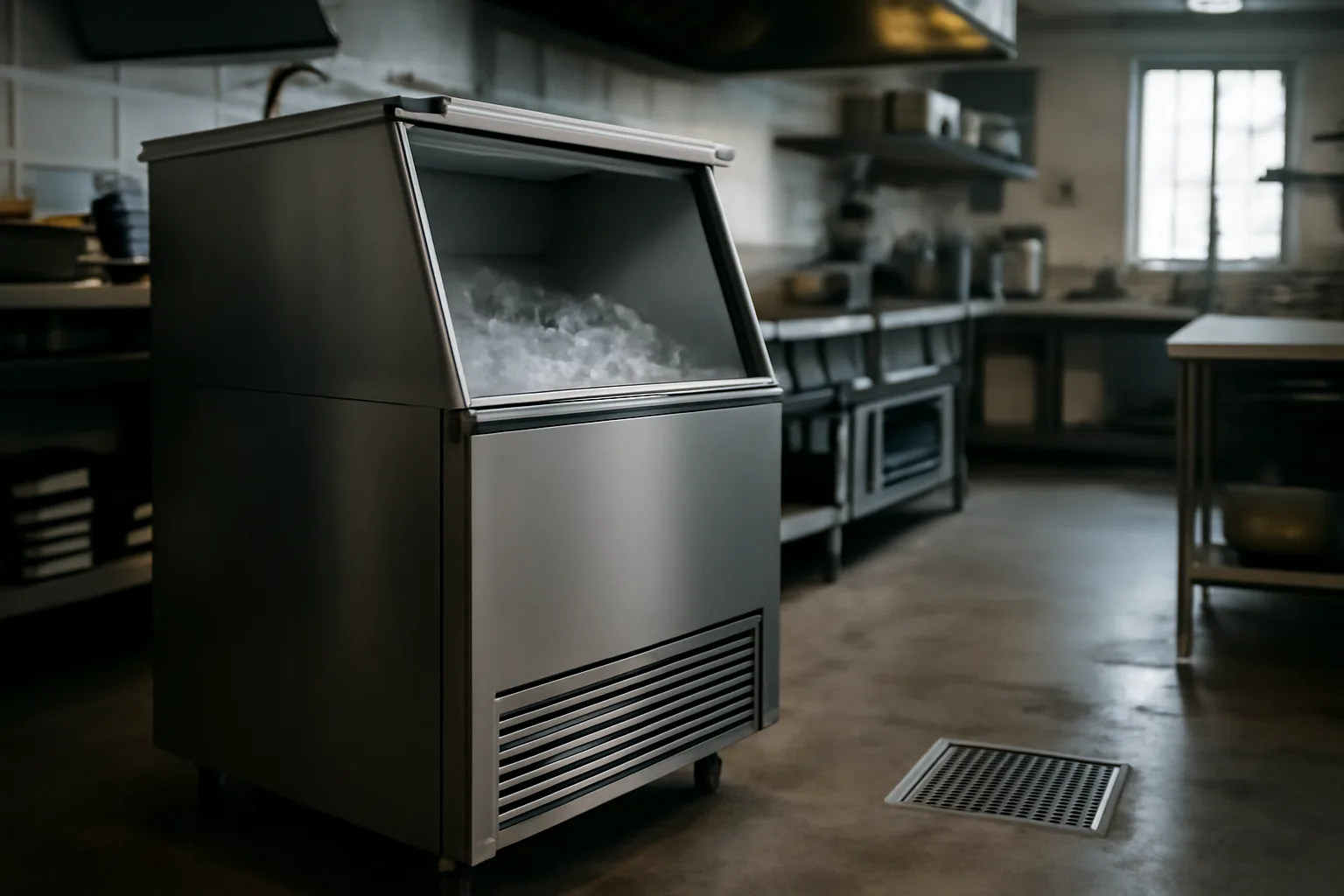
Most of the machines sit in restaurants, hotels, c-stores, hospitals, stadiums, and schools. You will see cuber, flaker, and nugget units, plus a few scale-ice machines. The bin and the dispenser fail as often as the freezer circuit. Water filters clog. Drains slime up. Controllers throw codes that often just mean the water is dirty.
The U.S. Bureau of Labor Statistics does not track ice-machine technician as its own occupation. The work sits inside heating, air conditioning, and refrigeration mechanics and installers. That group had a median annual wage of $57,300 in May 2023. [4] Ice-only specialists can land above or below that number. Nobody has a clean public wage table for ice routes alone.
The job is wet. You kneel on kitchen mats. You slide a 300-pound cuber off a stand with a helper who is late. You descale an evaporator that looks like a cave wall. Then you sanitize, because ice is food.
The FDA Food Code puts it plainly: "Ice for use as a food or a cooling medium shall be made from DRINKING WATER." [5] Health departments adopt versions of that code. A pink bin is not a cosmetic issue. It is a food-safety finding.
Some techs work dealer warranty. Some run independent PM routes. Some do both. If you hate talking to a kitchen manager at 4 p.m. on a Saturday, this is a bad fit. If you like repeat failures and accounts that reorder filters, it is a good one.
How do you start ice-machine tech?
You start ice-machine tech by passing EPA Section 608, confirming your state HVAC or refrigeration rules, buying a tight tool kit, and getting next to machines. There is no national ice-machine license and no federal start-date stamp.
Do this in order.
Pass an EPA-approved Section 608 exam first. 40 CFR 82.161 states that, effective November 14, 1994, "persons who maintain, service, or repair appliances, except MVACs, and persons who dispose of appliances, except for small appliances, MVACs, and MVAC-like appliances, must be certified by an approved technician certification program." [2] Ice machines are appliances with refrigerant in them. You will not legally purchase most refrigerants without the card.
Call the state board second. Employee work under a licensed contractor is legal in many states. Independent contracting for the public often is not, until you hold the right classification. California describes C-38 Refrigeration contractor work on the CSLB classification page. [9] Texas regulates air conditioning and refrigeration contractors in Occupations Code Chapter 1302. [11] Florida defines air-conditioning contractor categories in section 489.105. [10] Titles and exemptions differ. Confirm with the relevant board. I will not invent a fee, a quota, or a processing time.
Learn lockout and electrical practice third. OSHA's lockout/tagout standard at 29 CFR 1910.147 covers the control of hazardous energy during servicing. [6] 29 CFR 1910.333 covers electrical safety-related work practices. [7] Ice machines injure people the same way other equipment does: live power, unexpected start, wet floor.
Buy tools fourth. Recovery gear, a scale, gauges or a digital manifold, a meter, food-contact cleaner, sanitizer, and a way to move a machine. Fancy scan tools can wait.
Find accounts fifth. Dealers hire. Chains keep vendor lists. Independent restaurants hire the person who answers the phone. Manufacturer training helps on controllers. It is not a government license.
State money math is local. Compare a license-heavy market such as ice-machine tech cost in california with a tourism-heavy one such as ice-machine tech cost in florida or a smaller board such as ice-machine tech cost in idaho before you price your first PM.
Do you need EPA 608 certification for ice machines?
Yes, if you maintain, service, repair, or dispose of an ice machine that contains or may contain a regulated refrigerant. EPA Section 608 and 40 CFR part 82 make that a federal requirement, not a shop preference. [1] [2]
Small undercounter units often hold under 5 pounds of refrigerant. Those meet the small-appliance definition. 40 CFR 82.152 says a small appliance is "any appliance that is fully manufactured, charged, and hermetically sealed in a factory with five (5) pounds or less of refrigerant." [12] That points you at Type I. Larger cubers and many flakers run higher charges. Those sit in Type II territory (high-pressure appliances). Type III is low-pressure equipment, which you almost never see on an ice call. Universal covers Type I, II, and III.
I would just sit for Universal. The extra study time is small compared with driving back for another test.
EPA's technician certification page is the practical federal checklist: you need an EPA-approved testing organization, not a weekend YouTube badge. [1] HFCs used in many ice machines sit in the non-exempt substitute bucket as the AIM Act phasedown moves the market. [8] The card is how you buy the gas and how you stay on the right side of the venting rules.
The exam is closed-book at most approved orgs. Pass scores and retake rules come from the testing organization, not from a single federal fee table. Confirm the current exam fee with ESCO, HVAC Excellence, or whoever is offering the next Saturday seat near you.
Venting is illegal. 40 CFR 82.154 sets out the prohibitions on knowingly releasing refrigerant during maintenance, service, repair, and disposal. [3] If a tech tells you it is only a few ounces and to crack it to atmosphere, walk away.
| EPA 608 type | What the rule is aimed at | Typical ice-machine use |
|---|---|---|
| Type I | Small appliances, 5 lb or less | Many undercounter cubers |
| Type II | High-pressure appliances | Most larger cubers and flakers |
| Type III | Low-pressure appliances | Rare on ice calls |
| Universal | Types I, II, and III | What I would sit for |
What state license do you need to work on ice machines?
You need whatever HVAC, refrigeration, or contractor license your state and city require for the work you advertise. There is no 50-state ice-machine license. Employee status versus contracting for the public is the fork that changes everything.
If you are on someone else's payroll, many states let you turn wrenches under that contractor's license. If you put "ice machine repair" on a truck and invoice the restaurant yourself, you have crossed into contractor land in a lot of places. Confirm that line with the board. Do not take a forum post as the rule.
Three examples, not a national map. California's CSLB C-38 classification covers refrigeration equipment used for cooling, including work on related piping and units described on the C-38 page. [9] Texas Occupations Code Chapter 1302 is the air conditioning and refrigeration contractor statute. [11] Florida section 489.105 is where the construction-contractor definitions, including air-conditioning classes, live. [10] Those three states do not use the same words, the same exemptions, or the same money. That is the point.
Cities pile on business tax certificates, food-facility vendor rules, and sometimes a mechanical permit when you replace a unit. Hospitals and school districts add vendor credentialing that is not a state license and not optional if you want the account.
I would print the statute or classification page, then call the board with one written question: may I independently service commercial ice machines at food facilities in this state, and if not, what license name do I apply for? Get the answer in writing. Processing times change. Fees change. Anybody who quotes you a fixed approval window with no conditions is selling something.
If you are comparing start costs across boards, read ice-machine tech cost in arizona, ice-machine tech cost in georgia, and ice-machine tech cost in colorado next. Use them as checklists, not as a fee quote.
How much does it cost to start ice-machine tech?
There is no honest national start-cost number. EPA test fees are set by approved testing organizations, not by a single federal price list. State applications, bonds, and local business licenses are board-specific. Confirm every dollar with the org that cashes the check.
What I can say without making up a spreadsheet: the federal card is usually the cheap step. The expensive steps are the recovery machine, the vehicle, the bond or insurance the board or the chain account asks for, and the months you spend half-booked.
BLS reported a $57,300 median annual wage for HVACR mechanics and installers in May 2023. [4] That is a wage for employed techs in a mixed HVACR book, not a promise for a new ice route. A first-year independent can finish under that after parts, fuel, and unpaid drive time. A dealer employee can land near it faster, with worse hours.
Do not budget from a national myth. Alabama is not California. Hawaii is not Delaware. If you need a place to start the local math, use ice-machine tech cost in alabama or ice-machine tech cost in hawaii and then call the board listed there.
Waste of money in month one: vinyl wraps, a second brand of recovery machine, a trailer you cannot back into an alley, and prepaid "leads" for restaurants that already have a dealer. Spend on a scale that actually reads 0.1 oz, a meter you trust, and nickel-safe cleaner.
I will not invent a current license fee or a processing clock. If a blog lists one, it is already stale. Confirm with the relevant board.
What tools should you buy in year one (and skip)?
Buy the gear that lets you open a circuit legally, prove a water or electrical fault, and leave the bin food-safe. Skip almost everything else until a real job pays for it.
Must-have, in my order: EPA card in your wallet, recovery machine and tank you are allowed to use, refrigerant scale, hoses and core tools, multimeter, clamp meter, thermometer, flashlight, wet/dry vac, food-contact sanitizer, nickel-safe ice-machine cleaner, spare water filters for the brands on your route, and a hand truck that does not fold on a tiled kitchen floor. [1] [3]
Nice after the third paid leak: a megohmmeter for compressor windings, a borescope, and the manufacturer software dongle for the controllers you actually see. Buying every dongle on day one is how you fund the software companies instead of your rent.
Skip acid that is not labeled nickel-safe if you work plated evaporators. One wrong bottle and you own a new evap. Skip a full shelf of harvest solenoids "just in case." You will guess the wrong voltage. Skip the wrap-around branding on a van you still owe money on.
If you want a manufacturer-specific route checklist after you already have 608 and a board answer, IceMachinePath sells a $149 one-time Manitowoc/Hoshizaki Route Kit. You do not need it to follow this guide. The paper path above still comes first.
Street prices on recovery machines and meters move. Treat any dollar figure you see on a forum as an order of magnitude, not a quote.
How is ice-machine work different from general HVAC?
Ice-machine work is refrigeration plus potable water plus a food-contact surface that a health inspector can fail. Rooftop HVAC is air, filters, and a customer who notices comfort. Ice is a product they put in a glass.
You will spend more time on water than on gas. Inlet valves stick. Floats crack. Distribution tubes lime shut. Pumps lose prime. Harvest issues are often scale, not a weak charge. Techs who only think in superheat will replace compressors that were fine.
The bin is half the machine. Gaskets, door switches, agitators, and drain pans create the slime calls. The FDA Food Code frame still applies: ice is made from drinking water and used as food. [5] HVAC techs who will not clean a bin should stay on rooftops.
Charge sizes are often small. Many undercounter units sit at or under the 5-pound small-appliance line in 40 CFR 82.152. [12] You still recover. You still weigh in. You just do not get to bill a 12-pound top-off and call it a day.
Access is worse. You work behind a fryer, under a soda rack, at 11 a.m. while the line is firing. If you need a quiet mechanical room to think, this will grind you down.
What refrigerants and federal rules hit ice machines now?
Ice machines still use regulated refrigerants, so Section 608 still applies, and the AIM Act is changing which bottles you can buy over time. You service what is in the cabinet today. You do not vent it because a replacement refrigerant exists. [1] [8]
40 CFR 82.154 is the venting prohibition you actually work under. [3] 40 CFR 82.161 is the certification rule. [2] Together they are why a self-taught cleaner who never opens the circuit is in a different legal box than a tech who changes a drier.
The AIM Act, administered by EPA, is the federal HFC phasedown. New equipment and allowed refrigerants will keep shifting. [8] I would not stock a chest of yesterday's drums "because restaurants are slow to change." Buy for the job ticket. Recover what you pull. Confirm current sales restrictions with your wholesaler and with EPA's AIM materials, not with a group chat.
Drop-in folklore is expensive. A flaker with a flooded evaporator is not a toy for random blend experiments. If you are not the manufacturer, you do not get to invent a retrofit.
Keep your 608 card current in the sense that you still hold it and you still follow evacuation and recovery practice. The regulation does not create a cute national ice-machine endorsement on top of that. [2]
What health and food-code rules apply to ice?
Ice is food. The FDA Food Code says ice used as food or as a cooling medium shall be made from drinking water. [5] Many state and local health departments adopt that code or a close version. Your cleaning job is a food-safety job.
That changes how you work. You use cleaners and sanitizers labeled for the surface. You rinse the way the label says. You do not leave nickel-safe acid in a bin "to finish later." You do not set dirty panels inside the bin. You wash your hands like you are in the kitchen, because you are.
Inspectors look at bins, scoops, and the ice they plate. A black hinge line or a pink slime ring is an easy write-up. NSF and similar equipment standards are how a lot of machines get accepted into food facilities in the first place. You do not need to recite standard numbers on a PM. You do need to leave the machine in a condition that would not embarrass the operator.
Some counties want a food-handler card if you work inside an open kitchen. That is local. Confirm it. It is not a substitute for 608, and 608 is not a substitute for it.
If a manager asks you to "just scoop the ice into bus tubs and keep making product" while the bin is filthy, you can refuse the sanitation shortcut. You are the one whose name is on the ticket.
What does a first-year ice-machine route actually look like?
A first-year route is mostly filters, cleanings, no-ice calls, and drive time. Warranty swaps and full replacements show up. They do not pay the fuel bill every week.
Mornings start with a no-ice text from a cafe that ran a weekend without a PM. You check water first. Then power. Then the dump valve. Then the ice thickness bridge. Then, if you must, gauges. The techs who hook up gauges before they look at the inlet screen waste an hour and still miss the scale.
PM accounts are how you sleep. A quarterly clean on a busy cuber is boring and profitable. Chase-only service is how you live in your van. I would rather have 40 ordinary restaurants on a clean schedule than two stadiums that call at 9 p.m.
Nobody has good public data on how many stops a solo ice tech can hold. The closest official labor picture is still the BLS HVACR occupation page, which mixes this work with rooftops and walk-ins. [4] Treat any "80 stops a week" boast as marketing.
Credentialing will eat days. Chain vendor portals, hospital badging, background checks, proof of insurance. None of that is a state refrigeration license. All of it can block a paid job. Start the paperwork the week you get the 608 card, not the week the hospital finally calls.
Should you get NATE or other extra cards first?
No. Get EPA Section 608 and a clear answer from your state board first. Extra voluntary cards can wait unless a dealer writes the check. [1] [2]
NATE and similar programs are real industry credentials. They help some employers sort resumes. They are not a federal license to buy refrigerant and they are not a state contractor classification. I would not spend first-year cash there if the board still has not told you whether you may invoice the public.
Manufacturer training is different. Controller software, harvest logic, and parts diagrams are easier after a factory class. Take the class when you already see that brand every week. Taking five brand classes before you have five customers is a hobby.
OSHA-10 or a lockout class is the extra card I would actually budget, because 29 CFR 1910.147 is the rule you work under when you kill power to a machine. [6] It also photographs well on a hospital vendor form.
If a customer demands a specific badge, get that badge. Do not collect badges in the abstract.
What should you confirm with the board before you take a job?
Confirm, in writing, whether you may independently service commercial ice machines, what the license is called if you may not, and whether employee work under another contractor is allowed while you wait. Then confirm local business licensing and any food-facility vendor rule. Do not assume a YouTube "start tomorrow" script survived contact with your state.
Bring the federal piece already done. EPA 608 does not replace the board. The board does not replace EPA 608. [1] [2]
Ask about scope. Some classifications that sound like "HVAC only" still cover refrigeration equipment. Some do not. California's C-38 page and the Florida and Texas statutes above are examples of primary documents, not a complete map. [9] [10] [11] Your board's current application packet beats my paragraph.
Never invent a current fee, quota, or processing time, and do not let me do it either. If this page is still up in 2027, the board will have changed something. IceMachinePath is an independent publisher, not a law firm and not a service company. If you already have 608, a written board answer, and you still want the kit noted above, the start page is /start.
Call the board. Then take the first dirty cuber.
Frequently asked questions
What is ice-machine tech?
Ice-machine tech is commercial ice-maker service: install, clean, diagnose, repair, and replace cubers, flakers, nugget machines, bins, and dispensers. It is a slice of refrigeration work, not a separate federal occupation. BLS groups it with HVACR mechanics and installers. Ice is food, so sanitation is part of the trade, not an extra.
How do you start ice-machine tech?
Pass an EPA-approved Section 608 exam, confirm HVAC or refrigeration contractor rules with your state board, buy recovery and cleaning tools, then get next to machines through a dealer or independent accounts. There is no national ice-machine license. Confirm fees and titles with the board. Do not print truck lettering until that answer is in writing.
Can you service ice machines with only Type I certification?
Only small appliances. 40 CFR 82.152 sets the small-appliance line at five pounds of refrigerant or less, which matches many undercounter cubers. Larger ice machines are usually Type II. If you do not want to turn jobs down in a hotel basement, sit for Universal. Confirm the unit charge on the nameplate before you open it.
How long does EPA 608 take?
Study time is usually days, not months, if you already know basic refrigeration. The exam itself is a single sitting at an approved testing organization. Retake rules and scheduling are set by that org, not by a federal calendar. I will not invent a pass rate or a fee. Book the next local seat and use the official booklet they sell you.
Do you need a food handler card to clean a restaurant ice machine?
Sometimes. It is a local health-department rule, not a federal refrigeration rule. The FDA Food Code still treats ice as food made from drinking water, which is why your cleaning method matters even if nobody asked for a card. Ask the county that inspects the restaurant. It does not replace EPA 608.
Do you need recovery equipment for ice-machine work?
Yes, if you open a refrigerant circuit. 40 CFR 82.154 prohibits knowing venting during service and disposal. Small charge size does not create a venting exemption you can use on a busy Friday. Buy a recovery machine you are allowed to use and a scale that reads small charges. Borrowing a leaking unit from a cousin is how you fail a job and a rule at the same time.
Is ice-machine work covered by OSHA if you work alone?
OSHA standards such as 29 CFR 1910.147 (lockout/tagout) and 1910.333 (electrical safety-related work practices) are about the work, not about whether you have a shop foreman. A one-person van still has live power, unexpected starts, and wet floors. Work the lockout steps. A hospital vendor packet will ask how you do it anyway.
Can you start ice-machine tech part-time?
Yes, if your state allows employee or after-hours work the way you plan to invoice. Many people start as dealer helpers or as a side book under a licensed contractor. Independent advertising is the line that triggers contractor rules. Confirm that line first. Part-time still needs 608 if you touch refrigerant.
Are residential undercounter ice makers the same trade?
Same physics, worse parts support, smaller tickets. Many are small appliances under the 5-pound definition and still need 608 if you open the circuit. I would not build a business on home units unless you already have a residential refrigeration book. Restaurants reorder filters. Homeowners argue about a $90 trip charge.
Should you stock evaporators and compressors in year one?
No. Stock filters, inlet valves, common pumps, and the cleaner you already use. Evaporators are expensive, brand-specific, and easy to order wrong. Compressors need a diagnosed circuit, not a guess. The waste is sitting on a $2,000 part while the next call is a $12 dump valve.
Do hospitals require extra credentials beyond a state license?
Usually. Vendor badging, background checks, proof of insurance, and sometimes a site-specific safety orientation. Those are account rules, not a substitute for EPA 608 or the state contractor class. Start the packet early. A hospital will not wait while you hunt for a COI on the morning of the no-ice call.
Does manufacturer training replace EPA 608 or a state license?
No. Factory classes teach controllers, harvest logic, and parts. EPA Section 608 is the federal refrigerant rule. The state board decides who may contract with the public. Take manufacturer training when you already see that brand every week. It is useful. It is not paper that satisfies 40 CFR 82.161.
Sources
- eCFR, 40 CFR 82.161 Technician certification: Effective November 14, 1994, persons who maintain, service, or repair appliances (with listed exceptions) must be certified by an approved technician certification program.
- eCFR, 40 CFR 82.154 Prohibitions: Federal rules prohibit knowingly releasing refrigerant during maintenance, service, repair, and disposal of covered appliances.
- U.S. BLS Occupational Outlook Handbook, HVACR mechanics and installers: BLS groups this work under HVACR mechanics and installers and reported a median annual wage of $57,300 in May 2023, with no ice-only breakout.
- U.S. FDA, Food Code 2022: The Food Code requires that ice used as food or as a cooling medium be made from drinking water.
- OSHA, 29 CFR 1910.147 The control of hazardous energy (lockout/tagout): Lockout/tagout rules apply to servicing machines where unexpected energization can injure the worker.
- OSHA, 29 CFR 1910.333 Selection and use of work practices: OSHA electrical safety-related work practices apply when working on or near live parts and when de-energizing equipment.
- U.S. EPA, AIM Act: The AIM Act is the federal statute directing the HFC phasedown that changes which refrigerants enter the market over time.
- California CSLB, C-38 Refrigeration classification: California's C-38 classification describes refrigeration contractor scope for people who contract that work in the state.
- Florida Senate, Statute 489.105 Definitions: Florida section 489.105 defines contractor categories, including air-conditioning contractor classes, that a tech must check before contracting.
- Texas Legislature, Occupations Code Chapter 1302: Texas Occupations Code Chapter 1302 is the air conditioning and refrigeration contractor statute.
- eCFR, 40 CFR 82.152 Definitions: A small appliance is factory-charged and hermetically sealed with five pounds or less of refrigerant, which sets the Type I line.