Last updated 2026-08-21
TL;DR
Ice-machine tech is refrigeration work on commercial ice makers, plus water, sanitation, and food-contact rules. No national ice-machine license exists. Start with EPA Section 608 (Type II or Universal for most cubers), then confirm contractor or employee rules with your state board. Buy recovery equipment and a leak detector, and get live time on one machine family before you print invoices. Confirm every fee with the board that issues the card.
What is ice-machine tech?
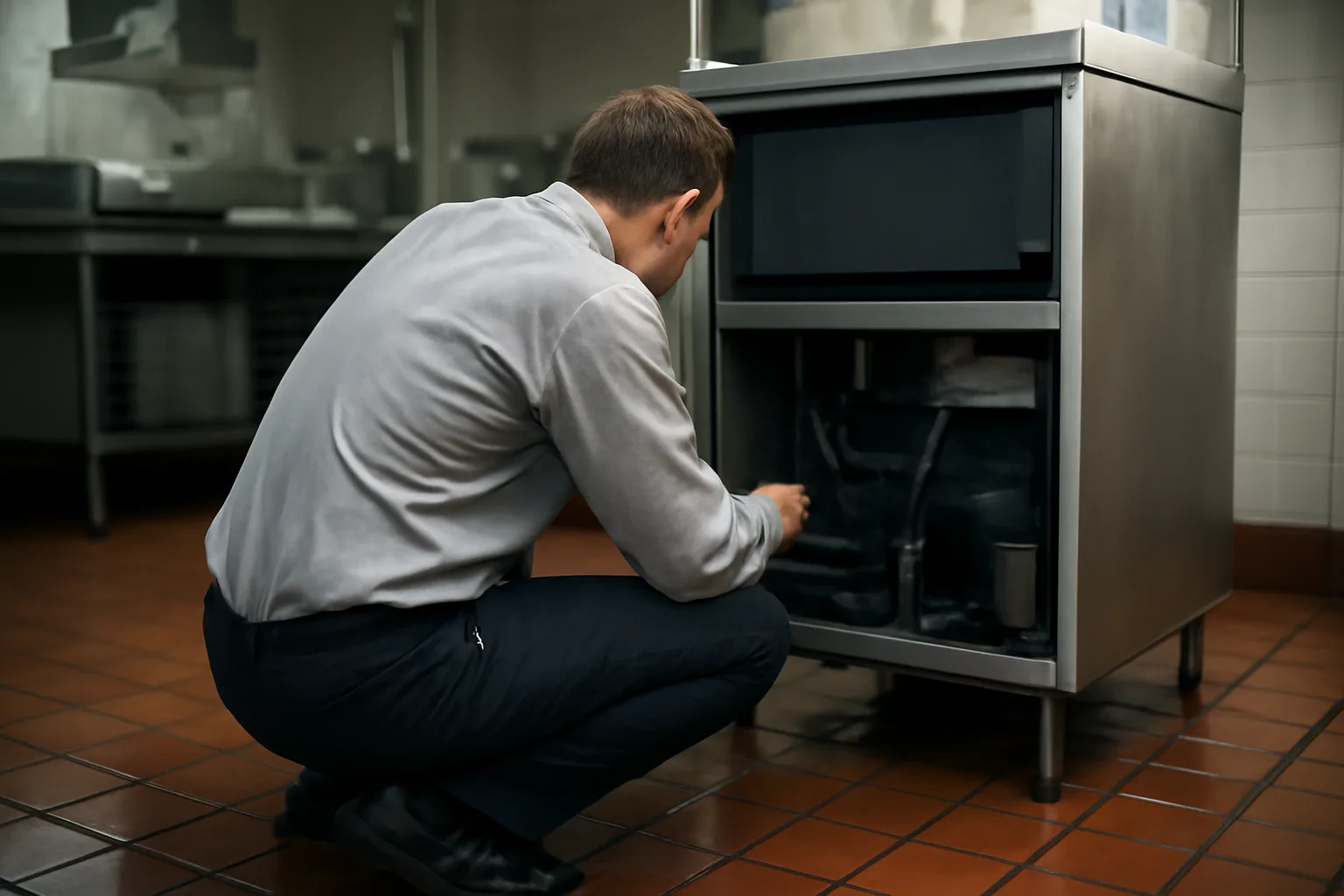
Ice-machine tech is field refrigeration work on machines that make, store, and dispense ice. Restaurants, hotels, hospitals, bars, stadiums, and c-stores own most of them. You install, clean, diagnose, and repair cubers, flakers, and nugget machines. You also fix the water side, because scale and dirt kill more ice machines than failed compressors do.
It is not a separate federal job title. The closest federal bucket is heating, air conditioning, and refrigeration mechanics and installers. BLS publishes that series. BLS does not publish an ice-only wage. Recent Occupational Outlook Handbook editions put the HVACR median annual wage in the mid $50,000s to about $60,000. Confirm the current May estimate on the BLS page before you quote it to a banker or a spouse.[5]
The work repeats. Freeze. Harvest. Rinse. Store. Air-cooled units fight kitchen heat and greasy condensers. Water-cooled units fight bad water and tower neglect. Flakers add gear motors, augers, and evaporators you do not treat like a cuber plate. Controls moved from mechanical timers to boards and sensors. The water circuit did not get any simpler.
Health departments care because ice is food. The 2022 FDA Food Code treats ice used as food or a cooling medium as a food product that must be made from drinking water.[6] That is why a moldy bin is not a cosmetic problem. It is a write-up.
If you like clean mechanical rooms and one equipment family, this niche will annoy you. Closets are tight. Floors are wet. You will drag a 500-pound cuber into a hallway at 10 a.m. while the line cook wants ice now. That is the job.
How do you start ice-machine tech?
You start ice-machine tech by earning EPA Section 608 certification, then matching the contractor or employee rules your state actually enforces, then getting live time on one or two machine families. There is no national ice-machine license. Paid work comes after the paper your board will honor, not after a weekend marketing course.[1][2]
Sit for Universal 608 first. Type II covers most commercial cubers. Type I only covers small factory-sealed appliances with 5 pounds or less of refrigerant. Plenty of undercounter units sit in that small-appliance bucket. Plenty of hotel and restaurant machines do not. Universal costs one extra sitting and keeps you legal when the next call is not an ice machine.[3][4]
Next, decide employee versus owner. Many states let you wrench under a licensed HVAC or refrigeration contractor without holding the contractor card yourself. The company holds the license. You still need 608 if you open a refrigerant circuit. If you invoice under your own name, ask the board whether ice-machine service is contractor work in that state. California publishes a C-38 Refrigeration contractor classification, for example. Other states look nothing like California. Confirm the current rule where you will work.[11]
Then get the tools that make 608 real. A recovery machine. A scale. A leak detector that finds the blends you will actually see. Gauges or digital manifolds. A thermometer you trust. Brushes and nickel test strips. Skip the wrapped van.
Going independent? Get a free EIN from IRS before you print invoices.[12] Register the business the way your city and state require. Insurance is next, not a logo. Local independent shops still hire helpers who can clean condensers and change filters while they learn harvest logic. That path is slower and cheaper than pretending you are a factory branch on day one.
State paper is local. Use a state walkthrough before you spend money. Start with how to start ice-machine tech in California or how to start ice-machine tech in Alabama if that is your map. Refrigerant law is also moving. HFCs are on a published federal phasedown, which is why 608 is not optional theater.
Do you need a national ice-machine license?
No. The United States does not issue a national ice-machine technician license. The federal piece is EPA Section 608 refrigerant handling under the Clean Air Act. State boards issue contractor, journeyman, or mechanical cards. Cities sometimes add their own. A private website cannot replace any of that.
Someone selling a national ice tech license is selling marketing. It will not satisfy 40 CFR 82.161. It will not satisfy a state contractor board. It will not impress a health inspector who wants to know who cleaned the bin.[2]
What people confuse with a national license is usually one of three things. EPA 608, which is real and federal. A manufacturer training card, which is useful for warranty work and is not a license. A trade-association certificate, which is resume paper unless your board listed it.
BLS notes that many states and localities require HVACR workers to be licensed, and that requirements vary.[5] That sentence is doing a lot of work. Vary means you cannot copy a Florida plan onto Utah or Vermont and call it done. Read Ice machine tech license in Utah: what you actually need or How to start ice-machine tech in Vermont: the real paper path, and then still call the board.
Keep a folder with 608, the state card if you hold one, the company contractor license if you work under someone else, and the insurance certificate accounts will request. That folder is the license stack. Everything else is optional.
What does EPA Section 608 actually require for ice machines?
If you maintain, service, repair, or dispose of an ice machine in a way that could release regulated refrigerant, you need EPA Section 608 technician certification. That is the federal gate. It does not disappear because the unit lives in a kitchen instead of on a roof.[1][2]
40 CFR 82.161 is blunt. It is a violation for a person to maintain, service, repair, or dispose of an appliance that could reasonably be expected to release CFCs, HCFCs, or their substitutes unless that person is certified as a technician under that section.[2] EPA's own certification page says Section 608 requires certification for persons who maintain, service, repair, or dispose of appliances containing regulated refrigerants.[1]
Know the types. Type I is small appliances. Federal rule defines a small appliance as a factory-charged, hermetically sealed unit with 5 pounds or less of refrigerant.[3] Type II is high-pressure appliances, which covers most commercial cube and nugget machines you find in restaurants. Type III is low-pressure chillers. Almost never your ice call. Universal is all three.[4]
Venting is its own violation. 40 CFR 82.154 prohibits knowingly venting refrigerant or a non-exempt substitute from an appliance while you maintain, service, repair, or dispose of it.[7] Recover into a proper cylinder. Use recovery equipment that meets the rule. Weigh what you take out when the job needs a real charge, not a guess.
Federal 608 credentials do not work like a driver's license with a printed expiration on the card. Programs and states can still pile on extra classes. Confirm the current EPA language and whatever your board added. Retake the material when a new blend shows up on your route, even if the card still counts.
Skip Type I-only if you want restaurant work. You will meet a 500-pound cuber in month one. Sit for Universal and be done.
What state paper do ice-machine techs need?
State paper is usually an HVAC, refrigeration, or mechanical contractor license for the firm that sells the work, plus whatever journeyman or technician card that state uses. Some states have no statewide HVAC license and leave it to cities. Some regulate only the contractor, not every helper. Confirm with the board. Do not guess from a forum post dated 2019.
California is the example people copy even when they should not. CSLB publishes a C-38 Refrigeration classification for contractors whose work is refrigeration systems. Ice machines usually sit in that family there. Read the current classification text on the CSLB C-38 page, then read ice-machine tech license in California for the rest of the stack.[11]
Arizona, Alabama, Utah, and Vermont do not share one form. Reciprocity is inconsistent. A card that works in one state can be worthless 50 miles over a border. If Utah is the plan, use Ice-machine tech board in Utah: licenses, costs, and timelines and still phone DOPL. If Arizona is the plan, start with ice-machine tech license in Arizona.
Installs and replacements can drag in electrical and plumbing permits. A plug-in undercounter swap is not the same job as a remote condenser on a roof. Ask the building department who can pull those permits. I have watched techs lose a day because they assumed ice work is always unlicensed maintenance. Sometimes it is. Sometimes it is an equipment change-out that needs a permit.
Ask the board four questions. Does ice-machine service require a contractor license if no refrigerant is added? Does an employee need a personal card? What exam, if any, applies? Do you accept out-of-state 608 plus experience? Write down the name of the person who answers. Boards change packet language. Your notes will matter more than a blog.
How much does the first year of ice-machine tech cost?
Nobody publishes a clean national first-year budget for ice-machine-only techs. Anyone who hands you one number is inventing a basket. The real pile is testing, hand tools, recovery gear, leak detection, insurance, a vehicle you already own or can afford used, and whatever your state and city charge for licenses and registrations.
EPA 608 testing fees are set by certifying organizations, not by a single federal price list. Confirm the current fee with the program that will seat you.[1][4] State license fees change by statute and by renewal cycle. Confirm those with the board that cashes the check. Ice-machine tech cost in Utah: licenses, training, and first-year expenses is the kind of state-level walkthrough you want, then you still verify the live fee table.
The expensive tool is the recovery machine, then a decent leak detector. Buy those before specialty cleaners in every brand's color. A used recovery unit from a retiring tech beats a financed stainless toolbox. Gauges, a scale, thermometers, a pump, brushes, and a multimeter cover most year-one calls. Manufacturer-specific boards and sensors wait until you have that brand on a route.
Insurance is not optional if you want restaurant accounts. General liability and the vehicle policy come first. Some accounts ask for additional insured certificates. Premiums are local. A broker who already writes HVACR is worth more than a national web form. Do not shop only on price.
Skip the lead-gen subscription in month one. Skip the wrap. Skip the $8,000 software stack. Invoice with something boring. Track parts on a spreadsheet until the volume hurts. First-year failure in this niche is usually overhead, not a lack of branded merch.
If you need one OEM paper stack, IceMachinePath sells a $149 one-time Manitowoc/Hoshizaki Route Kit. You can also collect current OEM manuals yourself and spend that money on a leak detector. The job does not require the kit.
Which certifications and classes are worth the money?
EPA Section 608 is worth the money because the law requires it before you handle regulated refrigerant.[1][2] A state contractor or journeyman card is worth the money if your board requires it to invoice. Everything after that is a business choice.
Manufacturer training is the next dollar I would spend, and only after you have machines of that brand. Warranty work and chain accounts often want to see it. The class also saves you two hours on a harvest problem you have never seen. Taking every factory class before you have a route is a hobby.
NATE and similar voluntary HVAC exams help a resume. They do not replace 608. They do not replace a contractor license. Sit one later if an employer pays, or if you are losing bids to firms that advertise it. Do not delay your first paid clean-and-sanitize waiting on a specialty patch.
Food-handler or sanitation short courses can help you talk to a health inspector without sounding lost. They are not a substitute for reading the ice and equipment-cleaning parts of the Food Code your local department adopted.[6] Ask the health department which edition they use. Many still run on an older Food Code than 2022.
Do not pay a private group for a title that sounds like a license. If the certificate is not on the EPA list and not on your board's list, it is decoration. Spend the day riding with someone who can show you a dirty water dump valve. That hour teaches more than a laminated card.
How do food codes and health inspectors treat ice?
Inspectors treat ice as food. The 2022 FDA Food Code states, "Ice for use as a food or a cooling medium shall be made from DRINKING WATER."[6] That sentence is why an ice machine on a questionable water line is more than an equipment issue. It is a food source issue.
Bins, chutes, and scoops are food-contact surfaces. Mold in the bin, a scoop left in the ice, a drain that backs up into the storage zone, and a machine that never gets a real clean are classic write-ups. Your job is half mechanical and half proving the ice leaving that bin is still food.
Local health departments adopt some version of the Food Code and then add their own. Confirm the edition and the ice-machine language with the department that inspects your accounts. Do not argue from a blog. Bring the code section and a written clean procedure.
Hospitals and some long-term care sites add water-management expectations because ice machines can grow organisms in standing water and warm lines. Even if you never take a healthcare account, the lesson stands. Stagnant water, warm bins, and skipped sanitizing are how a simple cuber becomes a complaint.
Sell cleaning on a calendar. A break-fix only model trains the account to call you after the inspector does. A documented clean, filter change, and condenser wash is boring work. It is also the work that keeps the machine legal and the ice usable. Price that contract before you price a compressor.
What refrigerant rules are changing for ice machines?
HFC refrigerants used in a lot of older ice machines are under a federal phasedown created by the AIM Act. EPA runs that phasedown in 40 CFR Part 84. The allowance schedule cuts U.S. HFC production and consumption to 90 percent of baseline in 2022 to 2023, 60 percent in 2024 to 2028, 30 percent in 2029 to 2033, 20 percent in 2034 to 2035, and 15 percent from 2036 on.[9][10][14]
That is why R-404A and other high-GWP charges got painful. New machines ship with different blends. Retrofit is not a casual top-off. Oils, seals, capacity, and listing all change. If you are not sure a blend is legal in that chassis, stop and read the nameplate and the manufacturer literature.
608 still applies. The phasedown does not hand you a free pass to vent a phasedown refrigerant because it is inconvenient.[7] Recover it. Record it when the job needs a record. Return or reclaim through a legal channel.
Efficiency rules sit next to refrigerant rules. ENERGY STAR publishes commercial ice machine criteria that buyers use on new purchases. You will walk into more units that were specced on kWh and gallons per 100 pounds of ice, not on whatever used machine was cheapest on a forum.[13]
Learn one current low-GWP family used by the brands on your route, and do not hoard random cylinders "in case." Cylinders have their own rules. Mixing leftovers is how you create a charge nobody can diagnose.
What does a real ice-machine service day look like?
A real day is more water than refrigerant. Clogged inlet screens. Failed water pumps. Scale on the evaporator. A dump valve that sticks and overfills the trough. Ice thickness probes that lie. A dirty condenser that looks like a kitchen filter. Then, sometimes, an actual leak.
You will start many calls with "it is not making enough ice." That sentence means nothing until you measure. Incoming water temperature. Incoming pressure. Condenser condition. Ice bridge or slab thickness. Cycle times. Bin control. A machine in a 95 F kitchen closet will not match a spec sheet written for a 70 F room. Tell the owner that with numbers, not vibes.
Flakers punish people who treat them like cubers. Auger bearings, gear motors, and float controls fail in ways a harvest timer never will. If you do not like mechanical drive systems, stay on cubers or learn fast.
Lockout and tagout is not paperwork theater when you pull an auger or reach a live pump. OSHA's 1910.147 control-of-hazardous-energy rule exists because people put hands in machines that restart.[8] Kill power the way the account's procedure and the law require. Wet floors plus 208-volt heat is a stupid way to end a Tuesday.
Parts are the hidden delay. A harvest valve or a board can sit on a truck for days. Carry the wear items you burn every week. Order the rest with the account's blessing before you promise same-day ice. Over-promising is how you work for free.
How do you get the first accounts without wasting money?
First accounts come from people who already trust you, then from independent restaurants that still pick their own vendor. Chains often want approved-vendor packets, insurance certificates, and sometimes factory credentials. That is later work.
Offer a paid clean, sanitize, and inspection with a written checklist. Include the condenser, the bin, the water filter date, incoming water temperature, and ice quality. Leave a copy. That single page sells the next visit better than a magnet.
Do not buy a national lead list. The good ice accounts already have a tech, a beverage house, or a restaurant-supply company in the building. You win when that person is slow, rude, or never cleans. Be the opposite. Show up when you said. Put the machine back together. Do not leave fittings in the bin.
Beverage and chemical salespeople know every dirty machine in town. A respectful relationship there beats ads. So does a fair subcontract from an HVAC shop that hates ice calls. Plenty of AC firms will hand you their ice work if you do not steal their cooling accounts. Put that in writing.
Price the cleaning contract so you can live on it. Break-fix only feels busy and pays in spikes. Summer heat plus a scaled evaporator is when owners suddenly have budget. Be on the route before that week.
What should you confirm with the board before you take paid work?
Confirm the live rule with the board that can fine you. Websites lag. So do articles, including this one. No approval timeline in a blog is a promise. Processing times change. Quotas, if a state even uses them, change. Fees change. Ask for the current application, the current fee table, and whether ice-machine-only service counts as contractor work.
Bring a specific fact pattern. "I will clean and sanitize ice machines and replace water filters, no refrigerant." Then, "I will recover and recharge commercial cubers." Then, "I will replace a whole ice machine on an existing disconnect." Those three jobs can sit in three legal buckets. Installs can need electrical permits. Drain work can annoy the plumbing trade in strict states.
Ask about employee status. Many boards let you work under a licensed contractor as long as the company holds the card and supervises the way the statute requires. If you hang your own shingle, the answer often flips. Get that in writing or in a dated email from the board.
Ask about exams, experience affidavits, and whether EPA 608 is accepted as the refrigeration portion. Ask about reciprocity. Then read the statute or rule they cite. If they cannot point to a section, you do not have an answer yet.
Do not take a paid refrigerant job in a strict state while the application sits in a pile. Cleaning under someone else's license is the safer early cash. Confirm even that. Boards disagree about what "cleaning" includes when you open a cabinet and start swapping valves.
Is ice-machine tech different from general HVAC work?
Yes, in the details that cost you time. The refrigeration core is the same. Superheat, subcooling, airflow or water flow across a condenser, a TXV or capillary that is starving or flooding. If you can do that, you can learn a cuber.
The extras are water chemistry, food contact, and harvest logic. A perfect charge on a scaled evaporator still makes ugly ice. A perfect compressor on a bin with pink slime still fails a health inspection.[6] HVAC techs who ignore water waste hours swapping parts. Ice techs who ignore airflow do the same thing on a dirty condenser.
Brand logic matters more here than it does on a 5-ton rooftop. Harvest sensors, water level probes, and control sequences are family-specific. That is why live time on one line beats owning every adapter. Learn one cuber family and one flaker family. Add the next brand when an account hands it to you.
Money is different too. HVAC has seasons. Ice has lunch. A dead machine at 11 a.m. is an emergency even in January. That can be good for a small route. It can also wreck your calendar if you never sell planned cleaning.
Treat ice-machine tech as a refrigeration specialty with a sanitation job glued to it. Keep your 608 current in practice, keep the board paper honest, and keep the bin clean. That is the whole trade.
Want a single place to start the paper checklist? Use /start. IceMachinePath is an independent publisher, not a law firm and not a service company. Confirm every fee, form, and timeline with the board that issues the card.
Frequently asked questions
What is ice-machine tech?
Ice-machine tech is installing, cleaning, diagnosing, and repairing commercial ice makers and their bins. It is refrigeration work plus water treatment and food-contact sanitation. BLS does not track it as a separate job. The closest federal series is HVACR mechanics and installers. Ice is treated as food under the FDA Food Code, so health rules sit next to EPA refrigerant rules.
How do you start ice-machine tech?
Get EPA Section 608 certification, then confirm contractor versus employee rules with your state board. There is no national ice-machine license. Add a recovery machine and leak detector, then get live time on one cuber family. If you invoice independently, get a free IRS EIN and the local business registrations your city requires. Confirm every fee with the board and the testing org.
Do I need EPA 608 to work on ice machines?
Yes, if you maintain, service, repair, or dispose of an appliance in a way that could release regulated refrigerant. That is Section 608 of the Clean Air Act and 40 CFR 82.161. Filter changes and bin cleaning with no circuit opening may sit outside that, depending on the job. When the circuit opens, 608 applies. Confirm gray areas with EPA guidance and your board.
Is there a national ice machine technician license?
No. The federal requirement is EPA Section 608 refrigerant certification. States and some cities issue contractor or mechanical licenses. Manufacturer cards and private association certificates are not national licenses. A site selling a national ice-tech license is selling paper your board will not honor.
What type of EPA 608 do commercial ice machines need?
Type II covers most restaurant and hotel cubers, which are high-pressure appliances. Type I only covers small factory-sealed appliances with 5 pounds or less of refrigerant, per 40 CFR 82.152. Type III is low-pressure chillers and is rarely an ice call. Universal covers all three. Universal is the sitting I would take.
Does EPA 608 certification expire?
Federal Section 608 technician certification is not set up like a driver's license with a routine expiration date on the credential. Your state board or an employer can still require extra classes. Refrigerant blends change, so the smart move is to refresh the material when your route does. Confirm the current EPA language and any state overlay before you skip a renewal class someone demanded.
Can I start ice-machine tech without an HVAC contractor license?
Often yes, as an employee of a licensed contractor, if your state uses that structure. Invoicing under your own name is the usual trigger for a contractor card. Some states have no statewide HVAC license and leave it to cities. Ask the board about ice-only service, refrigerant work, and full replacements as three separate questions.
How much does EPA 608 testing cost?
There is no single federal price. EPA-approved certifying organizations set their own exam fees and retake rules. Confirm the current amount with the program that will seat you, using the organizations EPA lists for Section 608 testing. Budget the exam, any practice book you actually need, and travel. I would not buy a long prep course unless you have never seen a refrigeration diagram.
Do restaurants and health departments treat ice as food?
Yes. The 2022 FDA Food Code says ice used as food or a cooling medium shall be made from drinking water. Local departments adopt some Food Code edition and inspect bins, scoops, and machines. A moldy bin is a food violation, not a cosmetic note. Ask your local department which edition they enforce.
Are manufacturer ice-machine trainings required by law?
No. Factory classes are not a substitute for EPA 608 or a state contractor license. They help on warranty work, chain vendor lists, and brand-specific harvest problems. Take them when you have that brand on a route or when an account requires the card. They are optional paper until a customer or warranty desk says otherwise.
What tools matter in year one of ice-machine tech?
A recovery machine, a scale, a leak detector, gauges or a digital manifold, a multimeter, thermometers, a pump, brushes, and water-test strips. Those cover legal recovery and most dirty-water calls. Specialty boards and brand-only fixtures wait until the route needs them. I would buy recovery and leak detection before a wrapped van or a software suite.
Can Type I 608 alone cover restaurant ice machines?
Usually no. Type I is for small appliances, meaning factory-sealed units with 5 pounds or less of refrigerant. Many undercounter units qualify. Many floor-model restaurant cubers do not. If the nameplate charge is over that threshold, you need Type II or Universal. Read the nameplate before you crack a service port.
Do I need an EIN to work as an independent ice-machine tech?
IRS lets many sole proprietors apply online for an EIN at no charge, and banks plus insurers often want one even when a Social Security number would technically work. It is cheap paper. Pair it with whatever state tax and local business registrations your city requires. Confirm those filings with the state revenue department and the city clerk, not with a Facebook group.
How often should commercial ice machines be cleaned?
Follow the manufacturer's cleaning interval and whatever your health department adopted. Hard water, grease-laden air, and heavy use shorten that interval. A written monthly or quarterly clean-and-sanitize with filter dates beats waiting for an inspector. Scale on the evaporator is both an ice-quality problem and a capacity problem. Do not wait for a no-ice call.
Sources
- U.S. EPA, Section 608 Technician Certification: Section 608 requires technician certification for persons who maintain, service, repair, or dispose of appliances containing regulated refrigerants.
- 40 CFR 82.161 Technician certification: It is a violation to maintain, service, repair, or dispose of an appliance that could release regulated refrigerants or substitutes unless the person is a certified technician.
- 40 CFR 82.152 Definitions (small appliance): A small appliance is a factory-manufactured, charged, hermetically sealed appliance with 5 pounds or less of refrigerant.
- U.S. BLS Occupational Outlook Handbook, HVACR mechanics and installers: BLS groups this work under HVACR mechanics and installers, publishes the median wage series, and notes that many states and localities require a license.
- FDA Food Code 2022 (official publication): Ice for use as a food or a cooling medium shall be made from drinking water.
- 40 CFR 82.154 Prohibitions: Knowingly venting refrigerant or a non-exempt substitute from an appliance during maintenance, service, repair, or disposal is prohibited.
- OSHA 29 CFR 1910.147 Control of hazardous energy (lockout/tagout): Servicing machines with unexpected energization or stored energy is covered by OSHA lockout/tagout requirements.
- 40 CFR Part 84 Phasedown of Hydrofluorocarbons: EPA implements the AIM Act HFC phasedown, including the allowance program that cuts HFC production and consumption on a published schedule.
- Federal Register, Phasedown of Hydrofluorocarbons allocation rule (Oct. 5, 2021): EPA's 2021 allocation rule establishes the HFC allowance program under the AIM Act.
- California CSLB, C-38 Refrigeration classification: California publishes a C-38 Refrigeration contractor classification covering refrigeration systems.
- IRS, Apply for an Employer Identification Number (EIN) online: IRS offers online EIN applications at no charge for eligible businesses.
- U.S. EPA, Frequent Questions on the Phasedown of Hydrofluorocarbons: EPA publishes the HFC allowance schedule as 90 percent of baseline in 2022-2023, 60 percent in 2024-2028, 30 percent in 2029-2033, 20 percent in 2034-2035, and 15 percent from 2036 onward.