Last updated 2026-08-21
TL;DR
Ice-machine tech is HVACR work: install, clean, diagnose, and repair commercial ice makers. No separate federal ice-machine license exists. Get EPA Section 608 Type II or Universal from an EPA-approved certifier first. Employees of licensed shops start there. If you bid your own work, confirm HVAC or refrigeration contractor rules with your state board. Ice is food under the FDA Food Code.
What is ice-machine tech?
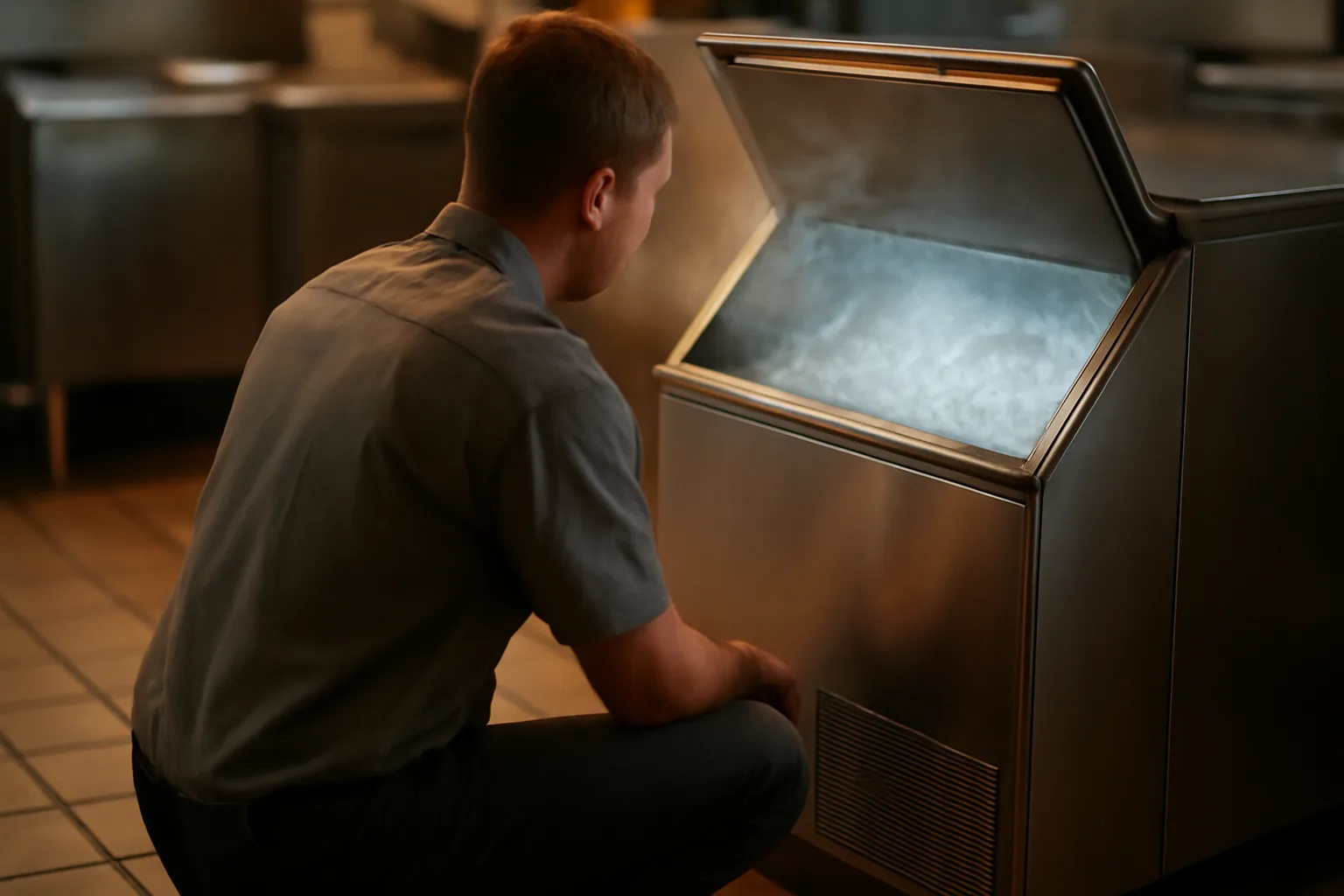
Ice-machine tech is the trade of installing, cleaning, diagnosing, and repairing commercial ice makers so they make safe ice at rated capacity. You work on cube, nugget, flake, and undercounter machines in restaurants, hotels, c-stores, stadiums, and hospitals. The skill set is HVACR plus water, harvest control, and food-contact sanitation.
No separate U.S. federal license titled ice-machine tech exists. The federal paper that always applies is EPA Section 608 technician certification when the unit uses refrigerant. State contractor licenses, if you run your own jobs, sit on top of that. BLS groups this work with heating, air conditioning, and refrigeration mechanics and installers (SOC 49-9021). [3][4]
You will spend more time on water filters, scale, dirty condensers, and failed harvest than on dramatic compressor swaps. Ice machines fail dirty. That is the job. People who only want refrigerant charging get bored and miss the callbacks that pay the week.
A commercial ice maker is a refrigeration system with an evaporator that freezes water, a harvest method (hot gas, a harvest valve, or a flexible evaporator), a bin or dispenser, and a lot of plastic and stainless that touches ice. Air-cooled units dump heat into the kitchen. Water-cooled units dump heat into a loop or tower. Remote condensers sit on a roof. You need all three layouts.
Wages follow the wider HVACR market. BLS reported a median annual wage of $57,300 for HVACR mechanics and installers in May 2023. [3] That is not an ice-only series. Ice routes can pay more when accounts are dense, or less when you drive 80 miles for a cheap clean. Nobody has good national wage data for ice-only techs. Treat ice-machine tech as a specialty inside HVACR, not a unicorn career.
How do you start ice-machine tech?
You start by getting EPA Section 608 Type II or Universal certification from an EPA-approved organization, then getting on the tools under a licensed HVACR or refrigeration contractor. Some states require a personal tech card even for employees. Confirm that split with the board. Do not bid independent work first.
Here is the order I would actually use.
Pass EPA 608. The exam is core plus the type. EPA does not administer the test itself. Approved certifiers do. Fees are set by those orgs, not by a federal price list, so confirm the current charge before you sit. [1][2]
Get hired. A year inside a restaurant refrigeration shop or an ice specialist beats buying a van on day one. You learn bin switches, PM contracts, and which hotels pay on time.
Add manufacturer training when you have a route that needs it. Hoshizaki, Manitowoc, Scotsman, and Ice-O-Matic each have harvest quirks. Paid OEM classes earn their cost. Random videos are not a substitute for a recovery machine and a water sample.
Still want your own company? Then do the business paper: entity, tax ID, insurance, and whatever HVAC or refrigeration contractor license your state uses. California treats refrigeration as classification C-38. [13] Texas regulates air conditioning and refrigeration contracting in Occupations Code Chapter 1302. [7] Florida defines air-conditioning contractor classes in section 489.105, Florida Statutes. [8] Those are examples, not a 50-state map. Confirm with the relevant board. No article can promise approval or a processing time.
State walkthroughs exist if you want the local stack, including how to start ice-machine tech in California and how to start ice-machine tech in Alabama.
Do you need EPA 608 certification for ice-machine tech?
Yes, if you maintain, service, repair, or dispose of an ice machine that contains and uses refrigerant. That is the federal rule, not a shop preference. 40 CFR 82.161 says, "No person may maintain, service, repair, or dispose of appliances that contain and use a class I or class II substance or a non-exempt substitute refrigerant, and no person may dispose of appliances that contain and use a class I or class II substance, unless such person has been certified as a Type I, Type II, Type III, or Universal technician." [1]
EPA approves certifying organizations. You pick one, study the core plus Type II (or Universal), and test. [2]
Type II covers high-pressure appliances, which is where almost every restaurant ice machine lives. Universal is Type I plus II plus III. I would take Universal. The extra sitting time is small, and you will get pulled onto a walk-in anyway.
| 608 type | What it covers | Ice machines |
|---|---|---|
| Core plus Type I | Small appliances | Rare, some tiny undercounter charges |
| Core plus Type II | High-pressure appliances | Most commercial ice makers |
| Core plus Type III | Low-pressure appliances | Almost never ice |
| Universal | Types I, II, and III | Best default |
Passing 608 does not make you a contractor. It does not replace a state license. It does not let you vent refrigerant. Section 608 of the Clean Air Act still prohibits knowing release of refrigerant during maintenance, service, repair, or disposal. [2]
If you only sanitize a bin and never open the circuit, some shops still want you certified so you are not the person who cracks a valve. I would get certified before I ever carry gauges. The card costs less than one bad recovery job.
What state license does ice-machine tech require?
It depends on whether you are an employee and on how your state writes HVAC, refrigeration, and contractor law. No single national ice-machine contractor license exists. Confirm with the relevant board. Do not treat a blog as a permit.
As an employee of a properly licensed contractor, many states let you work under the company's license once you have EPA 608. Some states still require a journeyman or tech registration. That is why you call the board.
If you advertise, bid, or invoice ice-machine work yourself, you are usually in contractor territory. California's contractor classifications include C-38 Refrigeration. [13] Texas Occupations Code Chapter 1302 governs air conditioning and refrigeration contracting, including who may perform and advertise that work. [7] Florida Statutes section 489.105 defines air-conditioning contractor classes used by the state licensing apparatus. [8] Utah construction trades licensing lives in Title 58, Chapter 55. [12]
License names lie. HVAC in one state includes ice. Refrigeration in another is a separate card. Plumbing boards sometimes claim ice makers because of potable water. Food-service health departments inspect the ice, not your refrigerant card.
I would not buy a contractor exam prep course until I can quote the exact classification code from the board website. People waste money on the wrong classification. If you need a state walkthrough, use ice-machine tech license in California and Ice machine tech license in Utah: what you actually need as starting points, then still confirm with the board.
How much does it cost to start ice-machine tech?
Nobody publishes an honest national first-year cost for ice-machine tech. Boards set their own fees and change them. I will not invent a current fee, quota, or processing time. Confirm those numbers with the certifier, the board, and your insurer.
The pieces you should budget, in order:
EPA 608 testing, paid to an approved certifier. Price varies by org and whether you retest.
Hand tools, a micron gauge, a scale, a recovery machine rated for the refrigerants you will see, a recovery cylinder that is in hydro date, a vacuum pump, nitrogen with a regulator, and leak detection you will actually use. Used recovery equipment is a real market. Cheap pumps that cannot pull a true vacuum are a waste of money.
Cleaners. Nickel-safe ice machine cleaner, sanitizer labeled for ice machines, filters, and a simple water test. Scale kills more ice machines than bad compressors.
If you are an employee, stop there. Let the shop fund the van, the inventory, and the insurance.
If you go independent, add business registration, the contractor application your state requires, general liability, commercial auto, and often workers' comp if you hire. Premiums are not a published federal schedule. Get quotes.
I would not finance a new cargo van in month one. A clean used van and a shop job is the cheaper path. Manufacturer tool kits can wait until you have accounts that use that brand.
For a sample of how a state stack looks when you add license plus training plus first-year cash, see Ice-machine tech cost in Utah: licenses, training, and first-year expenses. Utah is not your state unless it is. Use it as a pattern for the questions to ask.
What tools and classes are worth buying first?
Buy recovery, vacuum, and scale before you buy a thermal camera. You cannot do legal refrigerant work without recovery. You cannot trust a charge without a scale. Dye and guesswork are how you blow a compressor.
A decent manifold (or digital gauges), hoses that are not fossils, a tubing cutter, a flare or press setup that matches what you still see, a torque wrench for bits that specify torque, a good multimeter, and a clamp meter. Ice machines are electrical failures as often as they are sealed-system failures.
Water tools matter more than HVAC social media admits. TDS meter. Spare inlet valves. Extra float kits for the brands on your route. A wet/dry vac you are willing to destroy. Food-safe brushes. Do not use a wire brush on an evaporator the OEM says is coated.
Classes: EPA 608 first. Then a hands-on HVACR certificate or a registered apprenticeship if you can get into one. BLS lists a postsecondary nondegree award and long-term on-the-job training as the typical path into HVACR work. [4] NATE is optional resume polish. It is not a legal substitute for 608 or a contractor license.
OEM training earns its cost when you are drowning in one brand's error codes. It is a waste if you have never cleaned a condenser.
IceMachinePath is an independent publisher of these paper paths, not a law firm and not a service company. Use it to find the board, then read the board.
Is ice food, and why does that change the job?
Yes. Ice is food. That is why sanitation is part of ice-machine tech, not a side chore. The FDA Food Code 2022 defines food as "a raw, cooked, or processed edible substance, ice, beverage, or ingredient used or intended for use or for sale in whole or in part for human consumption, or chewing gum." [5]
You are not only a refrigeration tech. You are working on a food-contact device. Dirty ice makes people sick. Ice machines also show up in Legionella guidance because they hold water and they can aerosolize. CDC's ice machines module in the Legionella control toolkit exists because ice machines can be an exposure source in buildings. [9]
I would treat every PM as a sanitation job plus a mechanical job. Clean, rinse, sanitize, replace filters on a schedule the water quality actually needs, and write it down. Restaurants lose ice during a health inspection faster than they lose it from a weak harvest.
NSF/ANSI design standards apply more to the factory than to your personal license. You still need to use cleaners the OEM allows. The wrong acid eats nickel-plated evaporators. That callback is on you.
Scoop storage, bin gaskets, and the splash zone around a dispenser are part of the work whether you like it or not. If that bores you, stay on rooftop units.
What refrigerants and failures will you actually see?
Most food-service ice machines still use HFC blends (you will still see R-404A and R-134a in the field) and a growing set of lower-GWP options, including hydrocarbons such as R-290 on small charges. The AIM Act, enacted December 27, 2020, directs EPA to phase down HFC production and consumption. [10] That is why new model lists keep changing. Confirm the nameplate. Do not assume the last machine's refrigerant.
ENERGY STAR maintains a commercial ice machine product category because these units use a lot of energy and water in food service. [11] An efficiency label does not diagnose a failed harvest solenoid. It does tell an owner why they asked you to quote a replacement instead of another rebuild.
Real failures, in the order working techs actually live with: restricted water, scale on the evaporator, clogged air-cooled condensers, failed inlet valves, dirty sensors, bin control, harvest valve, then the compressor. Change a compressor without fixing the water, and you just bought yourself a second compressor.
Hot kitchens kill air-cooled machines. I would rather move air or add a remote condenser than keep adding charge. Charging by feel is how you liquid-flood a compressor.
Lockout/tagout is not optional when you stick your hands in an auger or a cutter grid. OSHA's control of hazardous energy standard (29 CFR 1910.147) is the federal rule shops already should be using. [6]
Should you start as an employee or open a route?
Employee first. I would not open a route until I could clean, sanitize, and diagnose the common brands without calling a group chat, and until I had written confirmation of my state's contractor rules.
As an employee you get the recovery gear, the account list, and the ugly 2 a.m. no-ice call with someone else paying the insurance. You also learn which chains pay in 60 days and which never will.
| Path | Typical paper | Who you bill |
|---|---|---|
| Employee of a licensed contractor | EPA 608, plus whatever tech card your state wants | Your shop |
| Independent ice-machine tech | 608 plus state HVAC or refrigeration contractor license, insurance, business registration | The account |
A route business is real. Restaurants need ice. PM contracts are the only way the work stays sane. Time and materials only is how you starve in February. The paper is heavier: contractor license, insurance, and the tax mess of a mobile service business.
Do not spend money on wrap and a trademark until you have signed PM accounts. That is a waste of money. Spend it on a working recovery machine and a second set of inlet valves.
If you want state-shaped start pages, how to start ice-machine tech in Arizona, How to start ice-machine tech in Vermont: the real paper path, and ice-machine tech license in Colorado show how different the same job looks once a board gets involved.
How do you confirm ice-machine tech rules with the board?
You confirm by reading the statute and the board's license classification, not by copying a Facebook comment. Pull the contractor classifications. Search refrigeration, HVAC, air conditioning, and mechanical. Call the board with the classification code in front of you and ask whether commercial ice-machine install and service is inside it. Get a name and a date. Boards do not like hypotheticals, so ask as a person who will apply.
Check EPA's list of approved 608 certifiers, not a random HVAC diploma mill. [2]
Check whether your city requires a local mechanical permit for a new install, especially remote-condenser roof work.
Check the health department's ice rules if you work in food service. The FDA Food Code is a model code. States and counties adopt versions of it. [5]
If the board website contradicts a training school, the board wins. IceMachinePath pages are a map to the paper, not a substitute for it. Still confirm fees and forms with the agency that cashes the check.
No approval guarantee. No timing guarantee. Anyone who sells you a guaranteed issue date is selling you something else.
What does first-year ice-machine tech work look like?
First year looks like PMs, no-ice calls, and learning how owners treat the bin like a trash can. You will descale. You will replace filters. You will argue about water quality with a manager who thinks city water is fine.
A normal PM: shut down, discard ice if the OEM and the health rule say to, clean the water system with the right cleaner, rinse, sanitize, clean the condenser, check inlet screens, verify harvest, verify bin control, leak check if you opened the circuit, document. If you never opened the circuit, you still did ice-machine tech.
Installs are leveling, drain pitch, air clearance, water pressure, and a dedicated circuit that is not shared with a toaster. Bad drains cause more the-machine-is-leaking calls than bad pumps.
Hospitals and some hotels will ask for extra documentation. That is normal. CDC's Legionella toolkit is one reason healthcare engineering teams look at ice machines. [9]
Shop helpers and apprentices still do the heavy lifting of first-year skill. BLS describes postsecondary training plus long on-the-job training as the usual HVACR entry path. [4] That matches this work. A weekend seminar does not.
What should you skip, and what should you do this month?
Skip national become-an-ice-tech-in-7-days funnels. Skip buying every OEM's full tool kit before you have that brand on a route. Skip advertising as a licensed contractor if you are not. Skip venting a little 404A because the cylinder is in the truck.
This month: pick an EPA-approved 608 certifier and schedule Type II or Universal. [2] Read your state contractor classification. Decide employee vs independent with that paper in hand. If you want a single packet of OEM-oriented route paper, there is a $149 one-time Manitowoc/Hoshizaki Route Kit, and the checklist lives at /start. Use it or ignore it. The legal path is still 608 plus your board.
Then go back to the board. Fees, forms, and timelines are theirs, not mine.
Frequently asked questions
What is ice-machine tech?
Ice-machine tech is HVACR work on commercial ice makers: install, clean, diagnose, and repair cube, nugget, flake, and undercounter units. You handle refrigerant, water, harvest, and food-contact sanitation. There is no separate federal ice-machine license. EPA Section 608 plus your state's contractor rules (if you bid your own jobs) are the real paper.
How do you start ice-machine tech?
Get EPA Section 608 Type II or Universal from an EPA-approved certifier, then work under a licensed HVACR or refrigeration contractor. Confirm with your board whether employees need a personal card. Manufacturer classes come after that. Open your own route only after you can quote the contractor classification your state actually uses.
Is EPA 608 enough to run my own ice-machine business?
No. 608 lets you handle refrigerant legally under federal rules. Bidding, advertising, and invoicing ice-machine work usually puts you in state contractor territory (HVAC, refrigeration, or mechanical, depending on the board). Confirm the classification before you print cards. Insurance and business registration sit on top of the license.
Should I get Type II or Universal 608?
Type II covers most commercial ice machines because they are high-pressure appliances. Universal adds Type I and Type III. I would sit Universal. The extra time is small, and shops will still send you to a walk-in or a comfort-cooling call. Confirm the current exam fee with the EPA-approved certifier you pick.
Can I work on ice machines as an employee without a contractor license?
Often yes, if your employer holds the contractor license your state requires and you hold EPA 608. Some states still want a journeyman or technician registration for employees. That split is board-specific. Do not guess from a neighboring state. Call with the classification code in front of you.
How long does EPA 608 certification take?
Study time is on you. Many people sit the exam in a day once they have studied core plus the type. EPA does not publish a single processing clock because approved certifiers run the tests and issue the cards. Confirm scheduling and any wait with the certifier. I will not invent a federal timeline.
Do ice machines fall under HVAC or plumbing?
Refrigeration and HVAC contractor classes usually cover the sealed system and the unit. Potable water, drains, and backflow can pull in plumbing rules on a new install. Health departments care because ice is food under the FDA Food Code. You may need more than one conversation: contractor board, local mechanical, and the health inspector.
Are manufacturer certifications required by law?
Not at the federal level. EPA 608 is the federal technician paper for refrigerant work. OEM classes from brands you actually service are useful for error codes and warranty politics. They do not replace 608 or a state contractor license. Buy them when the route has that brand, not as a starter badge.
What does a first-year ice-machine tech actually do all day?
Descales, sanitizes, changes filters, clears condensers, chases no-ice calls, and learns that water quality is the job. Sealed-system work happens, but dirt and harvest problems happen more. Document PMs. Level machines. Pitch drains. If you wanted only compressor swaps, this specialty will annoy you.
Do hospital ice machines have extra rules?
Often extra documentation and water-management attention, not a separate federal ice license. CDC's Legionella control toolkit includes an ice machines module because these units can be an exposure source. Facility engineering may want written clean-and-sanitize records. Confirm the hospital's policy. Do not skip lockout on auger machines.
Is a cargo van required to start ice-machine tech?
No. If you are an employee, the shop's van is the point. Independent work needs a way to carry recovery gear, cleaner, and parts, but a new wrapped cargo van in month one is a waste of money. A shop job plus a used vehicle is the cheaper first year. Confirm commercial auto with your insurer.
Where do I confirm fees, forms, and wait times?
With the EPA-approved 608 certifier for the exam, and with your state contractor board for licenses. City permit desks handle installs. Insurers quote their own premiums. Fees change. I will not invent a current fee or processing time. If a school and the board disagree, the board wins.
What cleaner should I use on nickel evaporators?
Use the nickel-safe cleaner the OEM specifies, then rinse and sanitize as the service manual says. The wrong acid eats plated evaporators and you own the replacement. This is not the place to get creative with hardware-store descaler. Keep food-safe brushes. Keep scoops out of the chemical bucket.
Can I skip sanitation if I only do refrigeration?
You can try. You will still get blamed when the bin fails a health inspection. The FDA Food Code treats ice as food. CDC also flags ice machines in Legionella guidance. A sealed-system hero who leaves slime in the sump is a bad ice-machine tech. Clean, rinse, sanitize, then diagnose.
Sources
- eCFR 40 CFR 82.161 Technician certification: No person may maintain, service, repair, or dispose of appliances that contain and use refrigerant unless certified as Type I, Type II, Type III, or Universal.
- U.S. EPA Section 608 Technician Certification: EPA approves certifying organizations and requires core plus a type exam for Section 608 technician certification.
- U.S. BLS OEWS May 2023, SOC 49-9021: HVACR mechanics and installers had a median annual wage of $57,300 in May 2023.
- U.S. BLS Occupational Outlook Handbook, HVACR mechanics and installers: BLS groups this occupation as HVACR mechanics and installers and describes typical entry as postsecondary nondegree award plus long-term on-the-job training.
- FDA Food Code 2022: The FDA Food Code defines food to include ice intended for human consumption.
- OSHA 29 CFR 1910.147 Control of hazardous energy (lockout/tagout): OSHA's lockout/tagout standard applies to servicing machines where unexpected energization or startup could cause injury.
- Texas Occupations Code Chapter 1302 Air Conditioning and Refrigeration: Texas regulates air conditioning and refrigeration contracting in Occupations Code Chapter 1302.
- Florida Statutes 2023 section 489.105: Florida Statutes section 489.105 defines air-conditioning contractor classes used in state contractor licensing.
- CDC Control of Legionella Toolkit, Ice Machines Module: CDC publishes ice-machine-specific Legionella control guidance because ice machines can be an exposure source.
- U.S. EPA AIM Act page: The AIM Act was enacted December 27, 2020 and directs EPA to phase down HFC production and consumption.
- Utah Code Title 58 Chapter 55 Construction Trades Licensing: Utah licenses construction trades, including contractor work, under Title 58, Chapter 55.
- California CSLB Description of Classifications: California contractor classifications include C-38 Refrigeration Contractor.