Last updated 2026-08-21
TL;DR
Ice-machine tech is commercial ice-maker service inside HVACR, not a separate federal license. Start with EPA Section 608 Type II or Universal, then confirm HVAC or contractor paper with your state board. Your first year is cleaning and water filtration far more than compressor heroics. Ice is food under the FDA Food Code. Confirm every local fee with the board.
What is ice-machine tech?
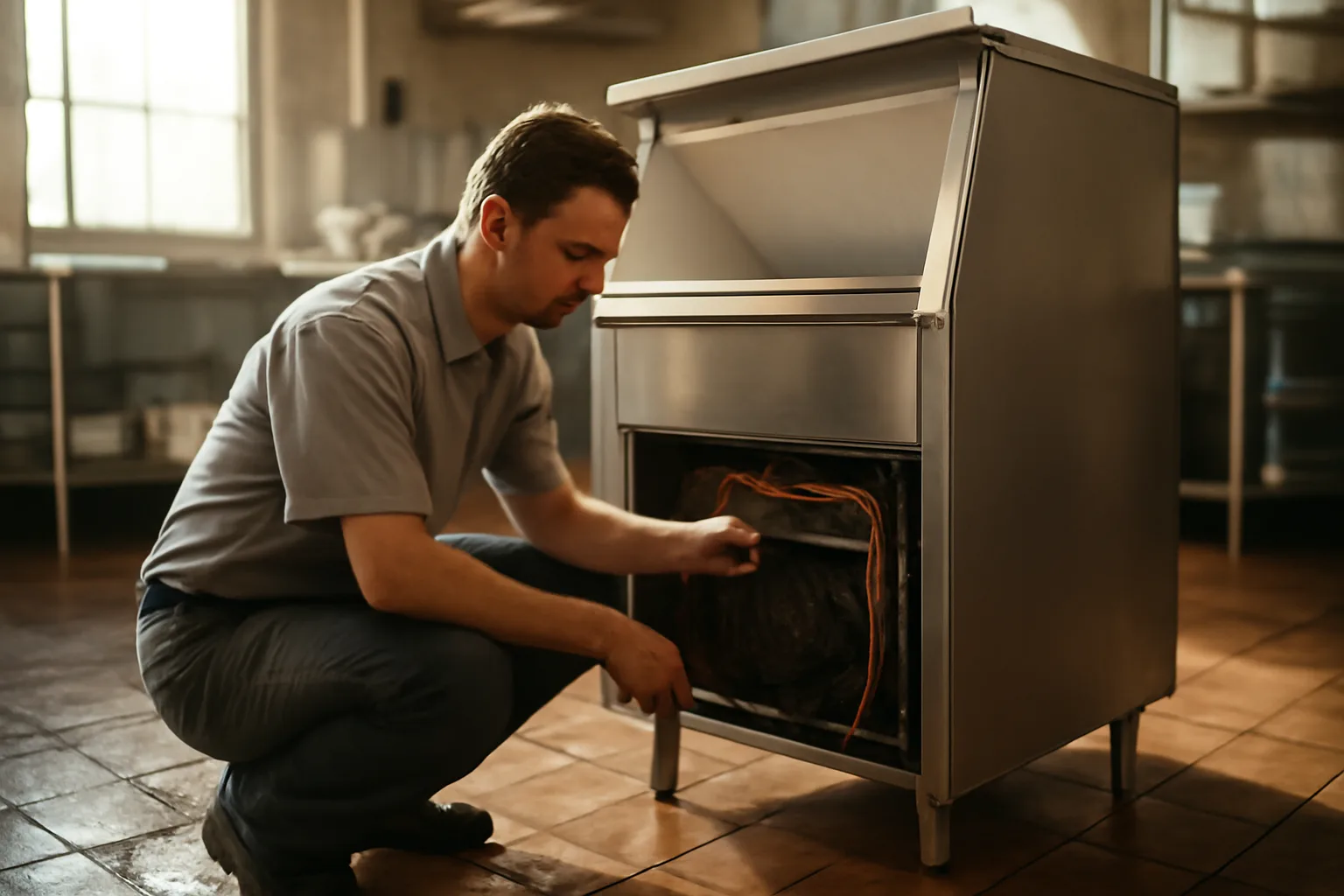
Ice-machine tech is field work on commercial ice makers: install, clean, diagnose, and repair the machine, the bin, the water filter, and the refrigeration circuit. It is HVACR work with a food-contact twist. Federal labor stats do not give ice-machine tech its own occupation code. The closest bucket is heating, air conditioning, and refrigeration mechanics and installers.
You will see cube, nugget, flake, and chewable ice machines. Some sit under a bar. Some are modular heads on a bin in a hotel basement. Water-cooled units dump heat into a condenser-water loop. Air-cooled units fight kitchen grease on the condenser. Remote condensers live on a roof.
DOE calls these automatic commercial ice makers and sets energy conservation standards in 10 CFR part 431, subpart H. [6] NSF/ANSI 12 is the sanitation and construction standard most health departments and foodservice spec sheets point at for automatic ice making equipment. [12]
The job is half water, half cold. Scale on an evaporator wrecks harvest. A plugged inlet screen starves the pump. A filthy condenser drives head pressure up and cooks a compressor. Sealed-system leaks happen. They are not most of the callbacks.
Ice is food under the FDA Food Code, so a dirty bin is not a cosmetic problem. [4] This is not residential fridge work. You are in restaurants before lunch, on a loading dock, or in a hospital pantry. You need refrigerant paper, electrical caution, and enough plumbing sense not to contaminate potable water.
How do you start ice-machine tech?
You start with EPA Section 608 technician certification, then you confirm HVAC, refrigeration, or contractor paper with your state board. There is no national ice-machine license. The 608 card is federal refrigerant-handling paper. State paper is whatever your board says a person must hold to advertise, pull permits, or work as a contractor.
EPA requires certification before you maintain, service, repair, or dispose of appliances that contain refrigerant. [1][2] For most commercial ice machines, people sit Type II (high-pressure) or Universal. Type I is only for small appliances with 5 pounds or less of refrigerant, per 40 CFR 82.152. [13] Read the nameplate charge before you assume Type I covers a unit.
After the card, pick a path. W-2 under a restaurant refrigeration shop is the cleanest first year. You get accounts, a recovery machine, and someone who already knows harvest pressures. Going independent on day one usually burns cash on a van, a hulking parts inventory, and zero route density.
State rules split. Some boards want a licensed HVAC or refrigeration contractor on the invoice. Some let an employee work under that license. Electrical and plumbing trades can get territorial if you run new circuits or alter potable piping. Call the contractor board before you print door magnets. Confirm every fee and form with that board. Nobody should quote you a processing time as a guarantee.
Manufacturer training helps you not void warranties. It does not replace 608. If you want cost context by state, start with ice-machine tech cost in california and ice-machine tech cost in florida. Those are local cost pictures, not a license grant.
Do you need an EPA 608 card for ice machines?
Yes, if you maintain, service, repair, or dispose of an appliance that contains refrigerant. 40 CFR 82.161 is the certification rule. [2] Cleaning a bin and changing a water filter, with no refrigerant work, is a gray area shops still train helpers on. The moment you attach gauges, recover, or replace a drier, you need the card.
EPA Section 608 technician certification is required before a person maintains, services, repairs, or disposes of appliances that contain refrigerant, under 40 CFR 82.161.
The venting rule is blunt. 40 CFR 82.154 says "no person maintaining, servicing, repairing, or disposing of an appliance or industrial process refrigeration may knowingly vent or otherwise release into the environment any refrigerant from such appliances." [8] Ice machines are appliances. The old "it is just a little 404A" excuse is still a release.
| 608 type | What it covers |
|---|---|
| Type I | Small appliances with 5 pounds or less of refrigerant |
| Type II | High-pressure appliances, most commercial ice machines |
| Type III | Low-pressure appliances |
| Universal | All of the above |
Test providers are EPA-approved organizations, not EPA itself. Fees and schedules are theirs. Confirm with the program you pick. I would take Universal if you also touch walk-ins. Type II alone covers a lot of ice-only routes, but Universal saves a second test later.
Keep the card. Some customers will ask to see it. Read the current EPA Section 608 technician page when rules or refrigerants move. [1]
What licenses and paper does a state actually want?
Your state wants whatever its contractor, HVAC, or mechanical board put in statute. That is not one list. Some states license refrigeration contractors. Some fold this into HVAC. Some care more when you bid as a business than when you are a W-2 tech under a licensed shop. Confirm with the relevant board.
I would not pay a permit runner until I read the statute. Look for HVAC/R contractor, mechanical contractor, and any specialty refrigeration class. Ask whether employee technicians need their own license or only the qualifying individual. Ask whether ice-machine-only service is even in scope.
Electrical work on a like-for-like controller swap is usually treated as equipment service. Pulling a new 30-amp circuit is electrical contracting in a lot of jurisdictions. Water connections can trip plumbing rules if you alter the building's potable system instead of a listed appliance connector.
OSHA still wants lockout/tagout when you service machines with hazardous energy. 29 CFR 1910.147 is the standard. [5] OSHA lockout/tagout rules in 29 CFR 1910.147 require a program of energy control procedures, employee training, and periodic inspections. OSHA 1910.333 covers live electrical work and when you must de-energize. [9]
Paper in the folder: 608 card, state license copy if you hold one, photo ID, and SDS for nickel-safe cleaner and sanitizer. This publication is not a law firm and not a service company.
State startup costs move. Compare ice-machine tech cost in alabama, ice-machine tech cost in arizona, and ice-machine tech cost in georgia rather than assuming a coastal fee schedule applies inland.
What does first-year ice-machine work look like?
First-year ice-machine work is mostly preventive cleaning, water filtration, and harvest complaints, not heroic compressor swaps. You will descale evaporators, sanitize bins, change filters, wash condensers, and chase ice that tastes like soda. Sealed-system jobs show up. They should not be your whole week.
If a shop tells you every call is a leak, that shop is bad at water chemistry.
A normal PM: shut down, discard ice, clean with a nickel-safe ice-machine cleaner, rinse, sanitize food-contact surfaces, check the inlet screen, verify the water sensor or float, inspect the dump valve, brush or wash the condenser, confirm the bin switch, and look at ice bridge thickness. Air-cooled condensers in kitchens load up with grease. Water-cooled condensers scale internally. Both kill capacity.
ENERGY STAR keeps a certified list of commercial ice makers that meet its energy and water criteria, which is useful when an owner asks about a replacement head. [7] DOE already set minimum efficiency for automatic commercial ice makers, so "efficient" on a flyer is not the same as beating the federal floor. [6]
Nobody has a clean national dataset on callback causes. Shop folklore says water and dirt dominate. That matches what the machines do: they freeze incoming water on a plate or in a barrel. I would sell filtration and a real PM before I sold a new evaporator.
Hospital accounts add infection-control expectations. CDC environmental infection control guidance has long treated ice machines as a water reservoir worth attention in health-care facilities. [11] Follow the facility protocol. Do not wing a quick wipe in a patient pantry.
How much does an ice-machine tech make?
Pay follows the HVACR market, not a special ice-machine union scale. BLS reports a median annual wage of $57,300 for heating, air conditioning, and refrigeration mechanics and installers in May 2023. [3]
The Occupational Outlook Handbook also reported that the lowest 10 percent earned less than $39,130 and the highest 10 percent earned more than $91,020 in that same May 2023 survey. [3] Ice-only route techs can land above or below that median depending on call density, after-hours restaurant work, and whether you are W-2 or self-employed. Nobody has good data on ice-machine-only wages. BLS does not split the occupation that fine.
Self-employed gross is not pay. Parts, fuel, insurance, recovery machines, and empty afternoons eat it. A dense restaurant district pays. A rural scatter of one hotel every 80 miles does not, unless you charge for windshield time.
I would take the W-2 number from a real refrigeration shop over an online six-figure ice pitch. Overtime in summer on walk-ins plus ice machines is how a lot of techs actually clear more. Straight ice in January is slower in many climates.
For a feel of startup cash by state, ice-machine tech cost in colorado and ice-machine tech cost in alaska are different worlds on travel and licensing, even if the 608 card is the same.
What tools should you buy, and what is a waste of money?
Buy a recovery machine, a vacuum pump, a scale, gauges or a digital manifold rated for the refrigerants you will see, a leak detector, an amp clamp, a thermometer, nickel-safe cleaner, sanitizer, a condenser brush, and a TDS or conductivity meter. That set lets you do honest diagnostics. A flashy van wrap does not.
Waste of money in year one: a full evaporator inventory for five brands, a second recovery machine for one refrigerant before you have that account, and any tool-truck drawer package that puts you in debt. Borrow the rare puller until a job pays for it.
R-290 (propane) machines need respect for flammability. Your leak detector and recovery setup have to match what the manufacturer and the refrigerant allow. Do not improvise with a torch around a hydrocarbon charge.
If you want a compact paper checklist for the two heads you will see constantly, IceMachinePath sells a $149 one-time Manitowoc/Hoshizaki Route Kit. It is optional study paper. It is not a license and it does not replace 608.
Lockout gear is not optional if you work for an employer covered by OSHA energy control rules. [5] A cheap lock and a hasp beat a surprise restart while your hands are in a cutter.
What do health inspectors check on ice machines?
Inspectors treat ice as food. The FDA Food Code states, "Ice for use as a FOOD or a cooling medium shall be made from DRINKING WATER." [4] That sentence is why a machine on a nasty water line, or a bin scooped with a beer pitcher, becomes a health write-up.
They look at the bin, the scoop and its storage, slime on curtains and evaporators, standing water, and whether the machine is cleanable. NSF/ANSI 12 exists so the equipment can actually be cleaned and so food-contact materials are appropriate. [12] A unit that cannot be descale-cleaned without destroying coatings will fail in the field even if it froze ice on day one.
Photograph the bin, the scoop well, and the incoming filter date on every PM. Restaurants lose scoop discipline fast. You will find the scoop in the ice. You will find soda syrup in the bin. That is a food complaint waiting on you, not a compressor.
Healthcare is stricter about waterborne organisms in ice machines. CDC environmental infection control guidance for health-care facilities discusses ice machines as a plumbing-related reservoir. [11] If the account has a protocol, follow it. If they want a clinical spec for patient ice, that is not a restaurant PM.
How do refrigerants and the AIM Act change ice-machine work?
HFC refrigerants used in many ice machines are under a federal phasedown. 40 CFR part 84 implements the HFC phasedown program that EPA runs under the AIM Act. [10] R-404A that used to be cheap is not cheap. That changes leak-versus-replace math on an old cube head.
Newer machines may use R-290 or other lower-GWP options. Hydrocarbon charges are small, but they are flammable. Follow the manufacturer's service manual. Do not treat R-290 like R-134a with a smile.
You still cannot vent. Recovery gear stays in the truck. If you cannot pass a vacuum on a wet ice machine that sat open, you do not charge it and hope. Ice makers are full of water by design. Moisture in the oil is how you buy a second compressor.
Learn nameplate reading before you memorize the usual gas for a brand. Charges differ by air-cooled, water-cooled, and remote. Wrong charge wrecks harvest. The HFC rules do not give you a new license. They change what you will find in the next replacement head you hang.
Do manufacturer trainings replace a state license?
No. Factory training on a Manitowoc, Hoshizaki, Scotsman, Ice-O-Matic, or Follett machine is product knowledge. Warranty work often requires it. A state contractor license is permission to operate in that state's trade framework. EPA 608 is refrigerant handling. Those are different stamps.
I would do factory training after I had 608 and a way to get on machines. Watching slides with no ice in the bin teaches less than one dirty restaurant condenser. Some makers sell online modules. Some still run in-person teardown classes. Confirm current prerequisites with the manufacturer, not with a forum screenshot.
Warranty parts are why shops chase the cert. Owners also like seeing a badge. Inspectors rarely ask for a factory badge. They ask whether ice is made from drinking water and whether the bin is filthy. [4]
Do not pay a third party who implies their certificate is a national ice-machine license. It is not. The federal paper is Section 608. [1] The local paper is your board.
Should you go W-2 or independent in year one?
Go W-2 unless you already have accounts. Independent work needs general liability, commercial auto, and, if you have employees, workers' compensation. I will not invent premiums. Carriers price those from your state, your driving record, and your trade class. Confirm with a licensed agent.
Contracts with restaurants should say who pays for a second trip when the store will not shut the machine down, and how after-hours is billed. Verbal "just keep us running" is how you work Saturday for free.
A shop already has recovery cylinders, a leak detector that works, and a parts account. That is worth more than a logo on a hatchback. After you know harvest times and water dumps in your sleep, then look at your own route.
If you want a starting checklist after you hold 608, go to /start. IceMachinePath is an independent publisher, not a law firm and not a service company.
What first-year mistakes waste money?
Skipping 608 and hoping a shop covers you when you attach gauges. Buying a box truck before you have a density of stops. Stocking evaporators for brands you have never been called on. Ignoring filtration and then eating callback labor. Working live when OSHA 1910.333 says de-energize. [9] Quoting a compressor before you proved a leak and a clean water system.
Also a waste: paying for national certification that is just a marketing PDF. The real federal paper is Section 608. [1] The real local paper is your board. Confirm it.
Scale is not a personality flaw in the owner. It is incoming water. If you do not measure hardness or TDS, you will replace parts that the next month of tap water destroys again.
Skip the box truck. Earn the route first.
If you are pricing a startup, read a state cost writeup such as ice-machine tech cost in arkansas. Use it as a prompt to call your own board, not as a fee schedule.
Frequently asked questions
What is ice-machine tech?
Ice-machine tech is installing, cleaning, diagnosing, and repairing commercial ice makers plus their bins, filters, and refrigeration circuits. It sits inside HVACR. Ice is treated as food, so sanitation matters as much as gauges. There is no separate federal occupation code. The closest BLS category is heating, air conditioning, and refrigeration mechanics and installers.
How do you start ice-machine tech?
Get EPA Section 608 Type II or Universal, then confirm HVAC, refrigeration, or contractor paper with your state board. There is no national ice-machine license. W-2 under a restaurant refrigeration shop is the sanest first year. Manufacturer classes help with warranty work later. Confirm every fee locally. Do not treat a processing time as a guarantee.
Is EPA 608 Type I enough for commercial ice machines?
Often no. Type I covers small appliances with 5 pounds or less of refrigerant under 40 CFR 82.152. Many commercial ice machines exceed that charge. Type II covers high-pressure appliances, which is the usual fit. Universal covers Type I, II, and III. Read the nameplate. Confirm with an EPA-approved certifying organization before you sit the test.
How much does EPA 608 certification cost?
EPA does not publish one national test fee. Approved certifying organizations set their own prices and schedules. Confirm with the program you pick. The card is federal refrigerant-handling paper, not a contractor license. Budget for the exam and a study book, then ask your state board what else it wants before you advertise.
Do ice-machine techs need a plumber or electrician license?
It depends on the board and on the task. Swapping a listed ice maker on existing connections is often equipment service. Running a new branch circuit or altering building potable piping can fall under electrical or plumbing contracting. Confirm with the relevant board. OSHA 1910.333 still applies to electrical safety even when a state license is not in play.
Does NSF/ANSI 12 matter if the unit already makes ice?
Yes, because ice-machine tech is food-contact work, more than refrigeration. NSF/ANSI 12 is the construction and sanitation standard for automatic ice making equipment. Inspectors care whether the bin and evaporator can be cleaned. A machine that freezes ice but cannot be descaled without wrecking coatings will fail in restaurants even if harvest looks fine on day one.
What refrigerant will I see on new ice machines?
Older commercial heads often used HFCs such as R-404A or R-134a. Newer equipment may use R-290 or other lower-GWP options as HFC supply tightens under 40 CFR part 84. Always read the nameplate. Hydrocarbon charges are small and flammable. Do not assume the gas from the last brand you serviced matches the next head.
Are hospital ice machines different from restaurant machines?
The refrigeration is similar. The hygiene bar is higher. CDC environmental infection control guidance treats ice machines in health-care facilities as a water reservoir. Follow the facility protocol, not a restaurant wipe-down. Scoop discipline, closed bins, and documented cleaning matter. Patient ice specs can be stricter than a bar account.
Can I start ice-machine tech without manufacturer training?
Yes. EPA 608 and whatever your state board requires come first. Factory classes help with warranties and control boards. They are not a license. I would get on real dirty machines under a shop before I paid for slides. Take manufacturer training once you have a path onto that brand's equipment.
What records should I keep after a refrigerant repair?
Keep your 608 card available, plus whatever recovery and service records 40 CFR part 82 requires for the appliances you open. Shops also keep SDS for cleaners and sanitizers. State contractor files are separate if you hold a license. Confirm current recordkeeping with EPA Subpart F and with your board. Do not invent a log format from a forum.
Is ice-machine tech the same as HVAC?
It is a slice of HVACR, not a different federal trade. You still handle refrigerant, motors, and water. You also deal with ice as food, NSF construction, and health inspectors. Residential furnace work will not teach harvest, dump valves, or bin sensors. Many techs do ice plus walk-ins because restaurants already have both.
How do I confirm my state board requirements?
Call the contractor, HVAC, or mechanical board that licenses refrigeration work where you will invoice. Ask whether ice-machine-only service needs a contractor license, and whether employees work under a qualifying individual. Confirm fees on that board's current fee page. Do not use another state's cost article as your invoice. No timing guarantees.
Sources
- U.S. EPA, Section 608 Technician Certification Requirements: EPA requires Section 608 technician certification for people who maintain, service, repair, or dispose of equipment that could release refrigerants.
- 40 CFR 82.161 Technician certification: 40 CFR 82.161 is the federal rule requiring technician certification for refrigerant work on appliances.
- U.S. BLS Occupational Outlook Handbook, HVACR mechanics and installers: Median annual wage for HVACR mechanics and installers was $57,300 in May 2023, with the lowest 10 percent under $39,130 and the highest 10 percent over $91,020.
- U.S. FDA Food Code 2022: The FDA Food Code requires ice used as food or a cooling medium to be made from drinking water.
- OSHA 29 CFR 1910.147 The control of hazardous energy (lockout/tagout): OSHA 1910.147 requires an energy control program with procedures, employee training, and periodic inspections.
- 10 CFR part 431 subpart H Automatic Commercial Ice Makers: DOE energy conservation standards for automatic commercial ice makers are in 10 CFR part 431, subpart H.
- ENERGY STAR Commercial Ice Makers product page: ENERGY STAR certifies commercial ice makers against its energy and water efficiency criteria and publishes a certified product list.
- 40 CFR 82.154 Prohibitions: Federal law prohibits knowingly venting refrigerant from appliances during maintenance, service, repair, or disposal.
- OSHA 29 CFR 1910.333 Selection and use of work practices: OSHA 1910.333 sets work practices for electrical safety, including when live parts must be de-energized.
- 40 CFR part 84 Phasedown of Hydrofluorocarbons: 40 CFR part 84 implements the federal HFC phasedown program.
- CDC MMWR Guidelines for Environmental Infection Control in Health-Care Facilities: CDC health-care environmental infection control guidance addresses ice machines as a water-related reservoir.
- NSF/ANSI 12 Automatic Ice Making Equipment (ANSI webstore): NSF/ANSI 12 is the American National Standard for construction and sanitation of automatic ice making equipment.
- 40 CFR 82.152 Definitions: Small appliance means equipment factory-charged with 5 pounds or less of refrigerant, which is the Type I 608 category.