Last updated 2026-08-21
TL;DR
Ice-machine tech is HVAC/R work on commercial ice makers: clean, diagnose, install, and repair. There is no federal ice-tech license. Start with EPA Section 608, then confirm contractor and business paper with your state board. Most year-one calls are water, scale, and dirt, not sealed-system heroics.
What is ice-machine tech?
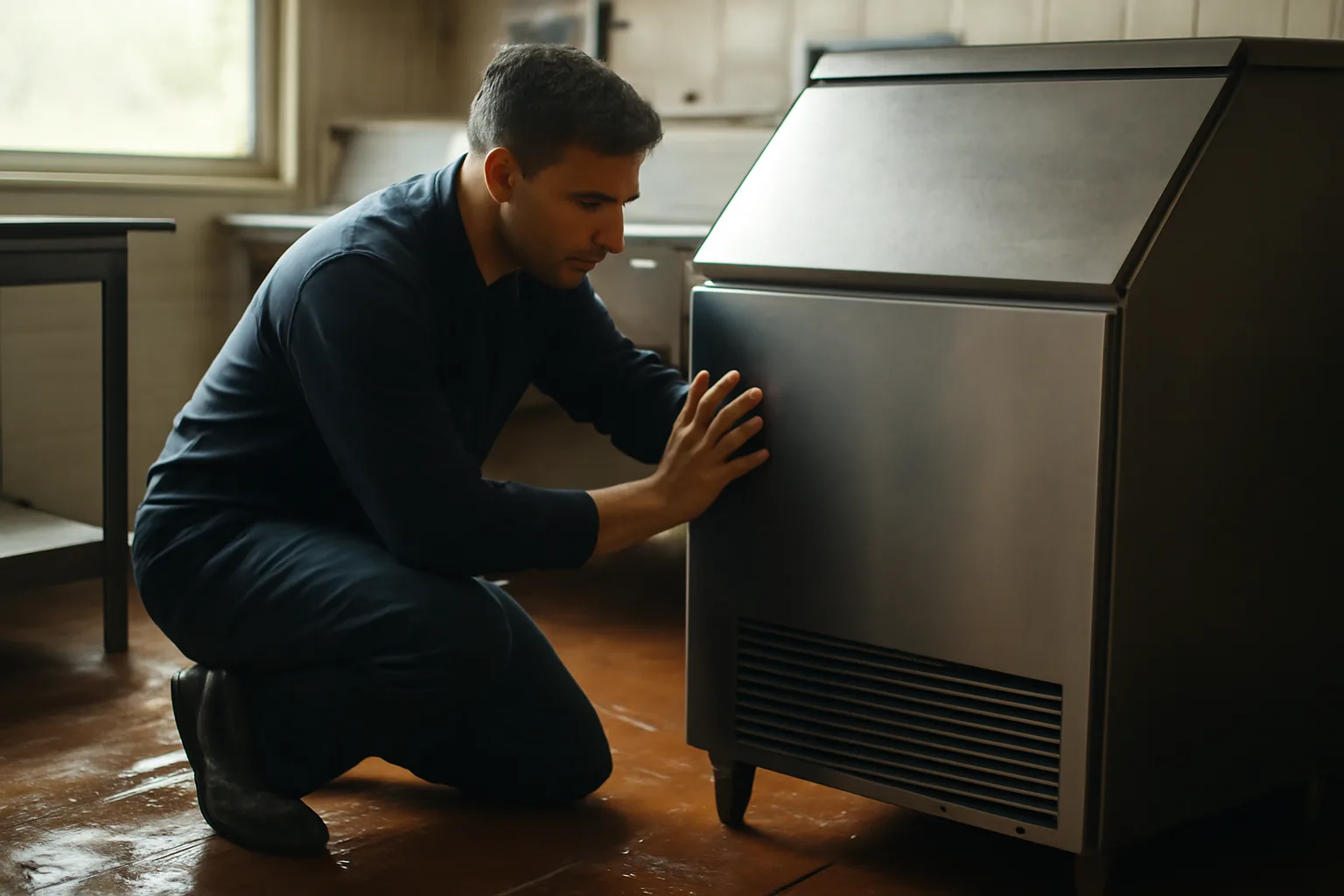
Ice-machine tech is the trade of installing, cleaning, diagnosing, and repairing commercial ice makers and their bins, plus the water, drain, electrical, and refrigerant gear bolted to them. It sits inside HVAC/R. It is not a separate federal occupation and it is not a national license.
You work on cubers, flakers, and nugget machines. Sites are restaurants, hotels, hospitals, schools, c-stores, and a few plants. The machine makes ice that people eat. That is why health inspectors care, and why a filthy evaporator is not a cosmetic problem.
Most of the hours are not glamorous sealed-system work. They are scale, slime, failed inlet valves, dirty condensers, bad bin switches, and drains that no longer slope. Refrigerant work still happens. When it does, federal refrigerant rules apply. The U.S. Bureau of Labor Statistics does not even list ice-machine tech as its own job. It folds the work into heating, air conditioning, and refrigeration mechanics and installers. [5]
People sell a myth that you need a special ice card before you can turn a screw. You do not. You need the same refrigerant handling certification other HVAC/R techs need, then whatever contractor paper your state actually writes down. Manufacturer classes from Manitowoc, Hoshizaki, Scotsman, and Ice-O-Matic teach the machines. They do not replace the statute.
If you like restaurant back rooms, odd hours, and machines that die on Saturday brunch, this trade fits. If you want a clean national credential you can print and forget, you are in the wrong shop.
How do you start ice-machine tech?
You start by getting EPA Section 608 technician certification, learning commercial ice-machine service, and then confirming with your state contractor board whether you also need an HVAC or refrigeration license to get paid. There is no federal ice-machine technician license. Do not buy one from a website that implies otherwise.
Sit the 608 exams through an EPA-approved certifying organization. Universal is the card I would take if I were paying for one test day, because Type II covers most cubers and you will still bump into small appliances. [1] After that, get your hands on real machines. Ride with a working tech if you can. If you cannot, take OEM service classes and practice cleanings until you can pull an evaporator without wrecking gaskets.
Then deal with the business paper. A city business license, sales tax account, and insurance are common. Contractor licensing is state-specific. California puts ice-making machines under the C-38 refrigeration classification. Other states use HVAC, mechanical, or refrigeration titles. Confirm the class and the exemptions with the board that issues the card. Never treat a blog fee table as current. [9]
Skip the $4,000 tool dump in month one. You need a scale, gauges or digital probes rated for the refrigerants you will see, a leak detector, a recovery machine and tank, electrical meters, nickel-safe cleaner, and a way to flush a water circuit. A vacuum pump comes when you are actually opening systems, not when a catalog says so.
Work under someone else's license until your state says you can contract. That is slower. It is also how you dodge a cease-and-desist letter in year one.
Do you need EPA 608 to work on ice machines?
Yes. If you maintain, service, repair, or dispose of ice machines that contain refrigerant, you must be Section 608 certified. That is the federal rule. Cleaning a bin with the power off and no refrigerant circuit opened is a gray area people argue about. Opening the sealed system, recovering charge, or scrapping a unit is not a gray area.
EPA's technician page states that Section 608 of the Clean Air Act requires certification for technicians who maintain, service, repair, or dispose of equipment that could reasonably be expected to release refrigerants. Ice machines are refrigeration appliances. They count. [1]
40 CFR 82.161 is the regulation that turns that statute into a prohibition. It restricts who may maintain, service, repair, or dispose of appliances that contain and use a class I or class II substance or a substitute. Modern HFC and HFO ice machines still sit in that world. [2]
Type I is small appliances, factory hermetic, five pounds or less of refrigerant. Type II is high-pressure appliances, which is most commercial cubers. Type III is low-pressure, which you will almost never see on an ice maker. Universal is all three. I would not sit Type I alone and call myself an ice tech.
The card does not prove you can set a water-cooled cuber on a bad tower loop. It proves you may handle refrigerant without being an easy EPA target. Pass the test. Keep a copy in the van. Then learn the machines.
What does Section 608 actually prohibit on a service call?
Section 608 prohibits knowing release of refrigerant during maintenance, service, repair, or disposal of air-conditioning or refrigeration equipment. You recover. You do not blow charge to atmosphere because a receiver valve is stuck and the customer is yelling.
EPA's Section 608 overview puts it in plain language: "Section 608 of the Clean Air Act prohibits the knowing release of refrigerant during the maintenance, service, repair, or disposal of air-conditioning or refrigeration equipment." That sentence is the job. [8]
The venting rule lives in 40 CFR 82.154. De minimis releases from good-faith recovery are treated differently from opening a liquid line and walking away. Do not play lawyer on a rooftop. Recover into a labeled tank with a certified recovery unit. [3]
Leak repair programs under 40 CFR 82.157 kick in on appliances with a full charge of 50 pounds or more. Most undercounter cubers are nowhere near that. A large industrial ice system can be. Comfort cooling leaks are judged at a 10 percent annual rate, commercial refrigeration at 20 percent, industrial process refrigeration at 30 percent. Ice plants can land in the commercial or industrial bucket depending on the installation. If the nameplate charge is 50 pounds or more, read 82.157 before you top off and go. [10]
Small appliance is a defined term, not a vibe. 40 CFR 82.152 says: "Small appliance means any appliance that is fully manufactured, charged, and hermetically sealed in a factory with five (5) pounds or less of refrigerant." If the unit does not meet that definition, Type I is the wrong card. [4]
The Clean Air Act provision behind all of this is 42 U.S.C. 7671g. You do not need to quote it to a restaurant manager. You do need to know it exists when someone tells you 608 is optional. [11]
Which state license do you actually need?
You need whatever HVAC, refrigeration, or mechanical contractor license your state board requires for the dollar amount and the equipment you will touch. Some states exempt employees working under a licensed contractor. Some exempt minor service under a dollar cap. Some do not. Confirm with the board. Do not guess from a Facebook group.
California's Contractors State License Board describes the C-38 refrigeration class as work that includes ice-making machines, along with other refrigeration equipment and insulated refrigerated spaces. If you plan to contract refrigeration work in California, that classification page is the document to read, not a recap. [9]
Other states use different names. Texas regulates air conditioning and refrigeration contracting under Occupations Code Chapter 1302. The exemptions and the license classes are in that chapter and in TDLR rules, not in a national ice-tech pamphlet. Read the chapter, then call TDLR if the exemption language is fuzzy for service-only work. [12]
A city business tax certificate is not a contractor license. A manufacturer pin is not a contractor license. EPA 608 is not a contractor license. Stack them only if each one is required.
If you only want to be a W-2 tech, your employer's license may cover the contracting side. You still need 608 in your own name. States do not let the shop's card ride in your pocket when you moonlight on Saturday.
Renewal is where people get sloppy. EPA 608 does not expire. State contractor cards do. If you later hold a license in Alabama or Alaska or Arizona, the renewal clock is a state problem, not an EPA problem. See ice-machine tech renewal in alabama, ice-machine tech renewal in alaska, and ice-machine tech renewal in arizona when you actually hold paper there.
What paper belongs in the first year?
Year-one paper is EPA 608, a photo ID, recovery cylinder certifications, SDS sheets for cleaners, and whatever business, tax, and insurance documents your city and state ask for. Add the state contractor application only when you are ready to bid work in your own name.
Keep the 608 certificate where an inspector can see it. EPA-approved certifying organizations issue the credentials. The agency's technician certification page is the place to confirm an organization is actually approved, not a random PDF in a forum. [1]
OSHA's lockout/tagout standard, 29 CFR 1910.147, applies in general industry when you service machines with electrical and mechanical energy. Ice makers have augers, gearboxes, and live panels. A written LOTO procedure sounds fussy until someone spins an auger with a hand in the evaporator. [7]
Insurance is not optional if you are contracting. General liability is the baseline. A customer will ask for a certificate before you walk into a hospital. Auto coverage on a van full of recovery tanks is its own conversation with an agent who has written HVAC accounts. I would not cheap out here. A $79 internet policy that excludes refrigerant work is a waste of money.
Sales tax on parts, lodging, and ice sales (if you ever sell ice, which most techs should not) is state revenue department territory. IceMachinePath publishes paper paths for people entering this trade. It is not a licensing agency and it does not collect board fees.
Build a folder: 608 card, recovery machine certification if you have it, cylinder date stamps, business license, insurance cert, and the OEM manuals for the brands on your route. Inspectors and parts houses both calm down when you can produce that stack.
How much money should you spend to start?
Plan for an EPA 608 exam fee set by the certifying organization, basic hand tools, a meter, gauges or probes, a leak detector, recovery gear when you will open systems, cleaners, and insurance if you contract. I will not quote a fake national total. Exam prices move. Board fees move. Confirm both.
The 608 test is cheap next to a bad recovery machine. Buy the exam from an EPA-approved organization listed on EPA's technician certification page. [1] Used recovery units are a false bargain if they cannot pull the refrigerants you service.
BLS reported a median annual wage of $57,300 in May 2023 for heating, air conditioning, and refrigeration mechanics and installers. Ice-only techs are not broken out. Rural restaurant routes will not match hospital union shops. Read the current Occupational Outlook Handbook table before you budget household bills against a median. [5]
Waste of money: national ice technician certificates, vinyl wraps before you have accounts, and a full nitrogen-purge station on day one. Worth the money: OEM training, a decent leak detector, nickel-safe cleaner, and a water test kit so you stop guessing at scale.
If you are an employee, let the shop buy the recovery machine. If you are bidding work, you need your own. Contracting without the state card to save a fee is how you fund a lawyer later.
Nobody has a clean public dataset on what a pure ice route nets in year one. The closest honest number you can take to a bank is still the BLS HVACR median, and even that mixes residential AC with supermarket racks. [5]
Is ice-machine tech different from HVAC?
Ice-machine tech is HVAC/R with a food-contact problem and a water problem. The refrigeration cycle is the same physics. The failure modes are not the same as a rooftop AC unit.
You live in water quality, flow control, harvest sensors, bin controls, and sanitation. A 3-ton split that will not cool is a charge or airflow story. A cuber that will not harvest is often scale on the evaporator, a weak harvest valve, or inlet water that is too warm. Same gauges. Different brain.
BLS still counts you as an HVACR mechanic. Employers do too, which is why many ice techs come out of restaurant refrigeration or building HVAC. [5] Pure ice routes exist in dense cities. In most counties you will also touch walk-ins and reach-ins if you want to eat.
Manufacturer procedures matter more here than on a lot of comfort cooling. Bridge a bin switch the wrong way and you flood a kitchen. Use the wrong acid and you ruin a nickel-plated evaporator. HVAC generalists who skip the ice-specific cleaning steps create callbacks.
I would still get Universal 608 and a solid electrical foundation. Then I would take brand service classes before I advertised as an ice expert. The paper is HVAC/R paper. The craft is ice.
How do health departments treat ice machines?
Health departments treat ice as food. A dirty machine is a food-contact violation, not a maintenance suggestion. That is why accounts will call you after an inspection even when the unit still makes cubes.
FDA Food Code 2022 is the model code many jurisdictions adopt or adapt. Ice used as food or as a cooling medium is supposed to be made from drinking water. If you work hospital or school kitchens, you will hear that language from inspectors who keep the code book in the car. [6]
The Food Code does not license ice technicians. It sets retail food practice. Local health departments write the inspection sheet you actually fail. Some want enclosed bins. Some want air gaps on drains. Some want a cleaning log. Ask the inspector or the operator for the local rule. Do not invent a national cleaning interval and print it on an invoice as law.
NSF/ANSI 12 is an equipment standard for automatic ice-making equipment. It is how machines get listed. It is not a person credential. Chasing an NSF tech card is a dead end.
Your job on the food side is simple. Use food-safe cleaners the OEM allows. Rinse like you mean it. Do not leave scale chips in the bin. Keep condensate and drain lines from feeding back into ice. If a machine cannot be cleaned into a sanitary state, say so and quote a replacement. Lying to keep a PM contract is how you inherit a norovirus story.
What refrigerants are you going to see on ice machines?
You will see leftover R-404A and R-134a, a pile of HFC/HFO blends, and more R-290 (propane) on smaller new cubers than people who left the trade in 2015 expect. Charge sizes on undercounter units are often small. That does not make 608 optional.
Substitutes sit inside the Section 608 universe. The technician certification rule reaches class I, class II, and substitutes. [2] Hydrocarbon machines still need correct recovery practice and a leak-tight charge. They also need you to respect flammability when you braze or spark-test in a closet.
The AIM Act HFC phasedown is why the blend list on your gauge set keeps growing. EPA's AIM Act page is the federal source for that policy. You do not need to recite allocation tables to change a TXV. You do need to stop treating every drum as if it will be cheap forever. [13]
Leak rates on 50-pound-plus systems still follow 40 CFR 82.157. Comfort cooling 10 percent, commercial refrigeration 20 percent, industrial process 30 percent. A hotel ice room full of 20-pound cubers is not that rule. A plant ice system might be. Read the nameplate. [10]
Drop-in folklore is a waste of money and a good way to ruin a compressor. If the OEM says a retrofit is not approved, it is not approved. Charge by weight. Ice machines are not an until-the-sight-glass-clears culture.
Does EPA 608 expire, and what about state cards?
EPA Section 608 technician certification does not expire. State contractor licenses do. Mix those two facts up and you will either overpay for a fake 608 renewal or let a state card lapse while you think the federal card covers you.
EPA's stationary refrigeration technician certification materials are the place to confirm current credential rules and the list of approved testing organizations. If a vendor is selling you an EPA 608 renewal course as if the card dies every two years, walk away. [1]
State boards set their own renewal cycles, CE, and late fees. Those numbers change. Confirm them on the board's renewal page for the year you are in. For examples of how renewal is a state problem, see ice-machine tech renewal in arkansas, ice-machine tech renewal in california, ice-machine tech renewal in colorado, ice-machine tech renewal in connecticut, ice-machine tech renewal in delaware, and ice-machine tech renewal in florida.
Georgia, Hawaii, and Idaho follow the same pattern: board rules, not EPA rules. ice-machine tech renewal in georgia is not a federal form.
Keep recovery cylinders in hydrotest date. That is DOT territory, not 608. An out-of-date tank can park your van even when your technician card is fine.
If you move states, 608 travels. The contractor license usually does not. Reciprocity is a board decision. Ask before you print invoices in the new state.
What would I skip if I were starting this week?
I would skip any school that promises a national ice-machine license. I would skip wrapping a van. I would skip buying every OEM parts kit just in case. I would sit Universal 608, buy a meter and a leak detector, and get on a truck that already has accounts.
I would take one manufacturer service class for the brand I will actually see. Two brands if I could afford the travel. I would not collect laminated certificates to impress nobody.
I would read 40 CFR 82.154 and 82.161 once, slowly. [2][3] I would put OSHA 1910.147 LOTO in the same afternoon, because ice machines eat fingers. [7] I would download the FDA Food Code ice provisions so a health inspector cannot bluff me. [6]
I would not bid a hospital PM contract on week two. I would not advertise 24/7 with no backup tech. I would not use hardware-store lime remover on a nickel evaporator.
If you want a starting checklist after you have read the statutes, use /start. IceMachinePath is an independent publisher, not a law firm and not a service company. No article can promise board approval or a processing time. Confirm fees, classes, and wait times with the board that takes the money.
Frequently asked questions
What is ice-machine tech?
Ice-machine tech is HVAC/R service on commercial ice makers and bins: cleaning, diagnosis, installation, and repair of water, drain, electrical, and refrigerant systems. It is not a separate federal license. Ice is treated as food under the FDA Food Code model, and refrigerant handling falls under EPA Section 608.
How do you start ice-machine tech?
Get EPA Section 608 certification from an EPA-approved organization, learn ice-machine service from OEM classes or a working tech, then confirm contractor licensing with your state board before you bid work. There is no national ice-tech card. Do not spend heavily on tools until you know whether you are an employee or a contractor.
Is there a federal ice-machine technician license?
No. The federal paper is EPA Section 608 for refrigerant work under the Clean Air Act and 40 CFR Part 82, Subpart F. Manufacturer training is voluntary. State HVAC or refrigeration contractor licenses, where required, come from the state board. Anyone selling a national ice license is selling paper that does not control the trade.
Which EPA 608 type do ice machines need?
Most commercial cubers are high-pressure appliances, which is Type II. Some small hermetic units can fall under Type I if they meet the five-pound small-appliance definition in 40 CFR 82.152. Type III is low-pressure and rare on ice. Universal covers all three and is the one sitting I would pay for.
Does EPA 608 certification expire?
EPA Section 608 technician certification does not expire. State contractor licenses usually do, on cycles the board sets. Ignore vendors who sell 608 renewals as if the federal card dies every two years. Confirm current EPA credential rules on EPA's technician certification page and confirm state renewal on the board site.
Can I clean an ice machine without 608?
Sanitizing a bin and evaporator without opening the refrigerant circuit is often treated as maintenance, not 608 work, but the moment you service the sealed system, recover charge, or dispose of the appliance, 40 CFR 82.161 applies. Many shops still want every tech 608-certified. Follow shop policy and do not vent.
Do health inspectors license ice technicians?
No. Local health departments inspect food facilities and treat ice as food under codes modeled on the FDA Food Code. They can fail a dirty machine. They do not issue a national ice-tech license. NSF/ANSI 12 lists equipment, not people. Your sanitation work still has to match the OEM procedure and local code.
Is ice-machine work the same as residential HVAC?
The refrigeration cycle is the same physics. The calls are not. Ice work is dominated by water quality, scale, harvest controls, and food-contact cleaning. BLS still files the job under HVACR mechanics. A strong HVAC generalist still needs ice-specific cleaning practice before taking restaurant accounts.
When do EPA leak repair rules apply to ice systems?
The 40 CFR 82.157 leak repair program applies to appliances with a full charge of 50 pounds or more. Annual leak rate thresholds are 10 percent for comfort cooling, 20 percent for commercial refrigeration, and 30 percent for industrial process refrigeration. Most restaurant cubers are under 50 pounds. Large plant ice systems may not be.
What tools are worth buying in month one?
A true-RMS meter, a leak detector, gauges or probes for the refrigerants on your route, nickel-safe cleaner, basic hand tools, and PPE. Add a recovery machine and vacuum pump when you will open systems. Skip van wraps, full OEM parts libraries, and nitrogen stations until accounts exist. Confirm 608 exam fees with the testing org.
Can I contract ice-machine work with only EPA 608?
Often no. 608 lets you handle refrigerant. Contracting is a state question. California's C-38 class expressly includes ice-making machines. Other states use HVAC or refrigeration contractor titles and exemptions. Work as an employee under a licensed contractor until your board says you may bid in your own name.
Where do I confirm fees and processing times?
Confirm 608 exam prices with an EPA-approved certifying organization. Confirm contractor application fees, quotas, and processing times with the state board that issues the license. Those figures change and are not honest if copied from an old article. No publisher can guarantee approval or a timeline.
Sources
- 40 CFR 82.161 Technician certification: Federal regulation restricts who may maintain, service, repair, or dispose of appliances that contain class I or class II substances or substitutes unless the person is certified.
- 40 CFR 82.154 Prohibitions: Knowing venting or release of refrigerant during maintenance, service, repair, or disposal of appliances is prohibited, with limited exceptions.
- 40 CFR 82.152 Definitions: Small appliance is defined as a factory hermetic appliance with five pounds or less of refrigerant.
- U.S. BLS Occupational Outlook Handbook, HVACR mechanics and installers: Ice-machine work is tracked under HVACR mechanics; BLS reported a median annual wage of $57,300 in May 2023 and notes refrigerant handling certification.
- U.S. FDA, Food Code 2022: FDA Food Code 2022 is the model retail food code; ice used as food or a cooling medium is to be made from drinking water.
- OSHA 29 CFR 1910.147 The control of hazardous energy (lockout/tagout): General industry lockout/tagout rules apply when servicing equipment with electrical and mechanical energy, including ice machines with augers and live panels.
- U.S. EPA, Stationary Refrigeration and Air Conditioning (Section 608): Section 608 of the Clean Air Act prohibits the knowing release of refrigerant during maintenance, service, repair, or disposal of air-conditioning or refrigeration equipment.
- California CSLB, C-38 Refrigeration classification: California's C-38 refrigeration contractor classification includes ice-making machines among the equipment the class may construct, install, maintain, and repair.
- 40 CFR 82.157 Appliance leak repair: Leak repair requirements apply to appliances with 50 pounds or more full charge; leak rate thresholds are 10% comfort cooling, 20% commercial refrigeration, 30% industrial process refrigeration.
- 42 U.S.C. 7671g National recycling and emission reduction program: Clean Air Act Section 608, codified at 42 U.S.C. 7671g, is the statutory basis for the refrigerant recycling and emission reduction program.
- Texas Occupations Code Chapter 1302 Air Conditioning and Refrigeration: Texas regulates air conditioning and refrigeration contracting, including license classes and exemptions, in Occupations Code Chapter 1302.
- U.S. EPA, AIM Act: The American Innovation and Manufacturing Act directs EPA's HFC phasedown, which is changing the refrigerants used in new refrigeration equipment including ice machines.